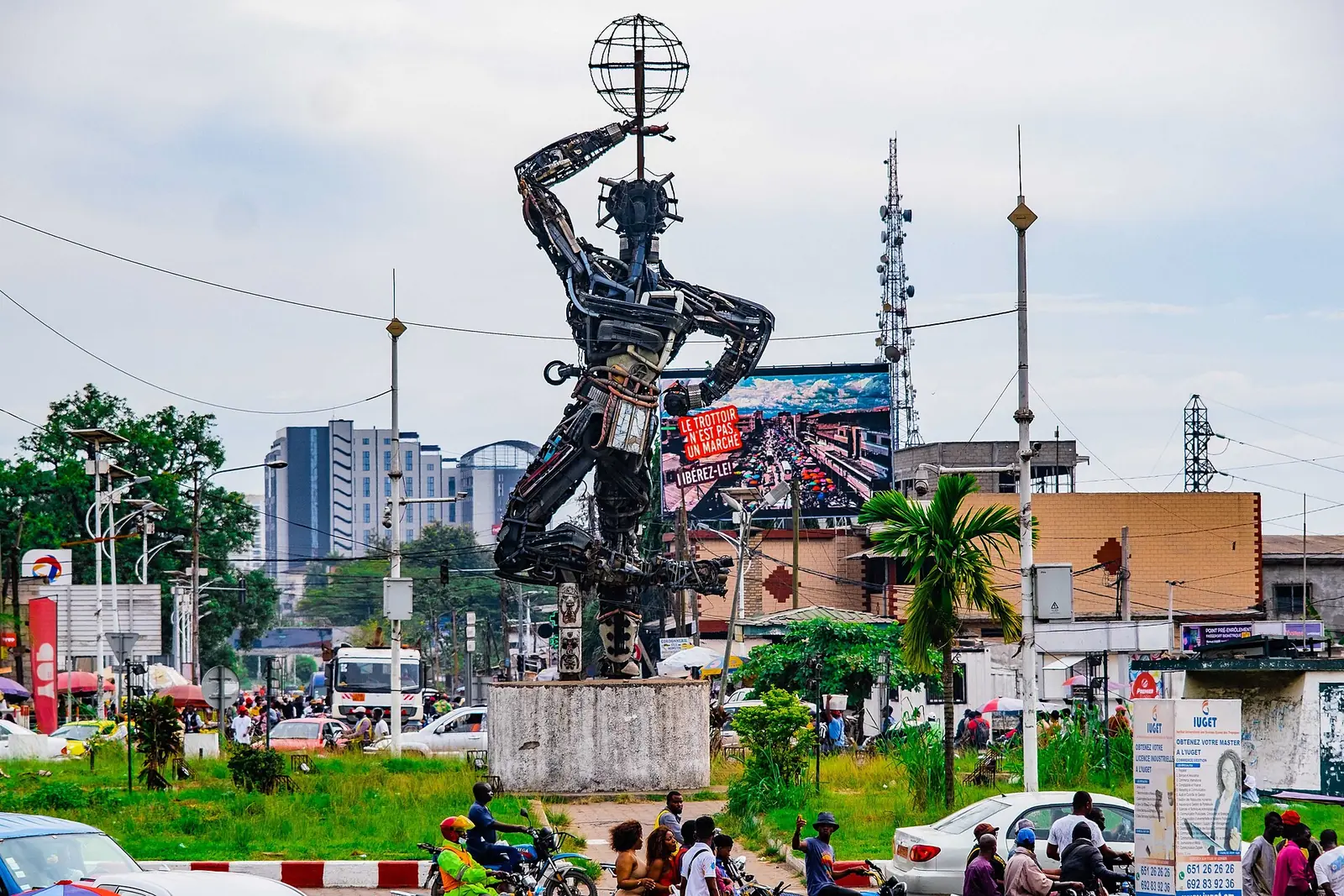
A figure of salvaged metal
La Nouvelle Liberté is a 12-metre figure assembled from salvaged metal, standing in the middle of the Deïdo roundabout, one of Douala's busiest junctions. doual'art, the art centre that commissioned it, calls it the city's most famous artwork and its symbol. French Wikipedia gives a span of 5 m and a mass of 8 tonnes, and describes scrap metal parts mounted on a boilermaker's frame.1,2
In a 2004 interview with Afrik.com, Sumégné described the figure as an athlete with a pharaonic bearing, set against the Statue of Liberty in New York, whose torch he read as a sign of conquest. His 'new liberty' was one of looking at oneself again and respecting others. He rejected the word 'recycling' as dismissive, preferring 'material seen a second time'. doual'art reads the work as a tribute to the city's habits of taking things apart, putting them back together and getting by.4,1
From a contested arrival to a city emblem
Sumégné, a self-taught painter and sculptor born in Bamendjou in 1951, made the sculpture during a residency with doual'art in Douala from 1993 to 1996; he told Afrik.com he spent two and a half years on it. Its arrival was contested. According to doual'art, French Wikipedia and the researcher Marta Pucciarelli, the first criticism was about its look and its scrap material, then part of the press turned on the artist's origins in the West Region, casting it as a quarrel between Douala's native and non-native residents, and the work was attacked and vandalised.3,4,1,2,6
The sculpture was nicknamed the Nju-Nju of Deïdo, the monster or evil spirit; the spelling varies between sources (Nju Nju, Nju Nau, Njo Njo). Sumégné recalled being called 'the madman of Deïdo'. It was only finished, and officially inaugurated, at the first Salon urbain de Douala (SUD), held from 9 to 16 December 2007. doual'art then gave it to the city, which paid for the plinth it stands on. The English Wikipedia list of public art describes the 2007 work as a restoration.1,2,4,5,12
Its place in the city
doual'art and Pucciarelli describe the roundabout as the gateway to the city: boulevards leave it for the centre through Akwa, for the eastern districts and, by the Wouri bridge and Bonabéri, for the west. After the donation, the city cleared the informal markets around it and added street lights, new paving and upkeep of the roundabout garden.1,6
Opinion softened over time. Pucciarelli, writing from fieldwork in 2012 and 2013, reports that in November 2010 residents gathered to stop a man who had climbed the sculpture to damage its head, and that 90.7 % of the people she surveyed in New Bell and Bessengué knew it as 'the sculpture at Rond-point Deïdo'. A Doppiozero article of 2017 calls it a symbol of the city despite its first reception.6,13
Seeing it today
The sculpture still stands. Dated photographs on Wikimedia Commons show it on the roundabout in April 2022 and June 2023, and French Wikivoyage listed it in an entry updated in March 2025. In November 2013, doual'art's restoration appeal listed mirrors to repair on the face and many small damaged details across the body; we found no later report on its condition.8,9,10,7
It stands on the central island of the Rond-point de Deïdo, in Douala I, and is seen from the surrounding streets; there is no building to enter and no opening hours.11,1
Map
What visitors say
We summarise accounts published elsewhere and link to the original. These aren't reviews collected by this site, and we don't show a rating.
Driving round the roundabout, he explained that the Nju-Nju tells people nothing should be thrown away: old clothes, old shoes, everything can be used again.
A taxi driver, quoted by the researcher Marta Pucciarelli, 15 January 2013
Check before you go
Our sources can't yet confirm these points:
- Its current condition, and whether the face mirrors and other details flagged in 2013 were repaired
- Who maintains it today, and whether it is lit at night
- The usual spelling of its Duala nickname (Nju-Nju, Nju Nau, Njo Njo)
- Whether 1996 marks its installation on the roundabout or only the end of the residency
Also nearby
Sources for this page
Information checked on 18 November 2026. It may have changed since.
- La Nouvelle Liberté de Sumegne, doual'art (undated)
- La Nouvelle Liberté, Wikipedia (French) (22 November 2025)
- Joseph-Francis Sumégné, Wikipedia (French) (30 July 2026)
- L'orfèvre de la récupération (interview with Joseph-Francis Sumégné), Afrik.com (12 May 2004)
- Festival SUD 2007, doual'art (undated)
- Douala Final Report (Mobile A2K, Culture and Safety in Africa), 2014, with fieldwork from December 2012 to January 2013, Marta Pucciarelli, SUPSI Laboratory of visual culture (archived copy) (undated)
- Douala Métamorphoses : patrimoine en péril !, doual'art, crowdfunding appeal on KissKissBankBank (closed 29 November 2013) (29 November 2013)
- Statut de la nouvelle liberté 04 (photo dated 18 April 2022), Evr1rd, Wikimedia Commons (18 April 2022)
- Monument de Rond-point Deido 01 (photo dated 5 June 2023), Felixdiga, Wikimedia Commons (5 June 2023)
- Douala, Wikivoyage (French) (8 March 2026)
- Rond-Point de Deido, map address looked up by us on 18 November 2026, OpenStreetMap Nominatim (undated)
- List of public art in Douala, Wikipedia (English) (16 April 2026)
- Making Douala 2007-2017, Chiara Somajni and Iolanda Pensa, Doppiozero (14 July 2017)
Enquire about La Nouvelle Liberté
Visit La Nouvelle Liberté
Plan your trip to La Nouvelle Liberté in the Littoral Region. Send us an enquiry about guided tours, accommodation and transport, and we'll reply by email.
Send an enquiryLittoral Region
Capital: Douala
Cameroon's economic centre, around the port city of Douala and the Wouri Estuary, with Sawa and Bassa heritage, the Ngondo festival and the Sanaga River at Edéa.
More places in the Littoral Region
Douala Maritime Museum
A ship-shaped museum in Douala's Bonanjo district on Cameroon's coast, ports and ships, with a recreated ship's bridge and a navigation simulator.
La Pagode (Palace of King Bell)
The former palace of the Bell kings in Bonanjo, Douala, built in 1905 and still owned by the Bell family. It was home to Rudolf Duala Manga Bell, hanged by the German authorities in 1914.
Ekom-Nkam Waterfalls
A waterfall of about 80 m on the Nkam river near Melong, set in forest and used as a filming location for Greystoke (1984). A second fall runs beside it in the rainy season.
Wouri Estuary
The tidal estuary where the Wouri, Mungo and Dibamba meet the Atlantic at Douala, lined with mangroves and fishing villages, and the source of Cameroon's name.