A viewpoint, a garden and a water organ
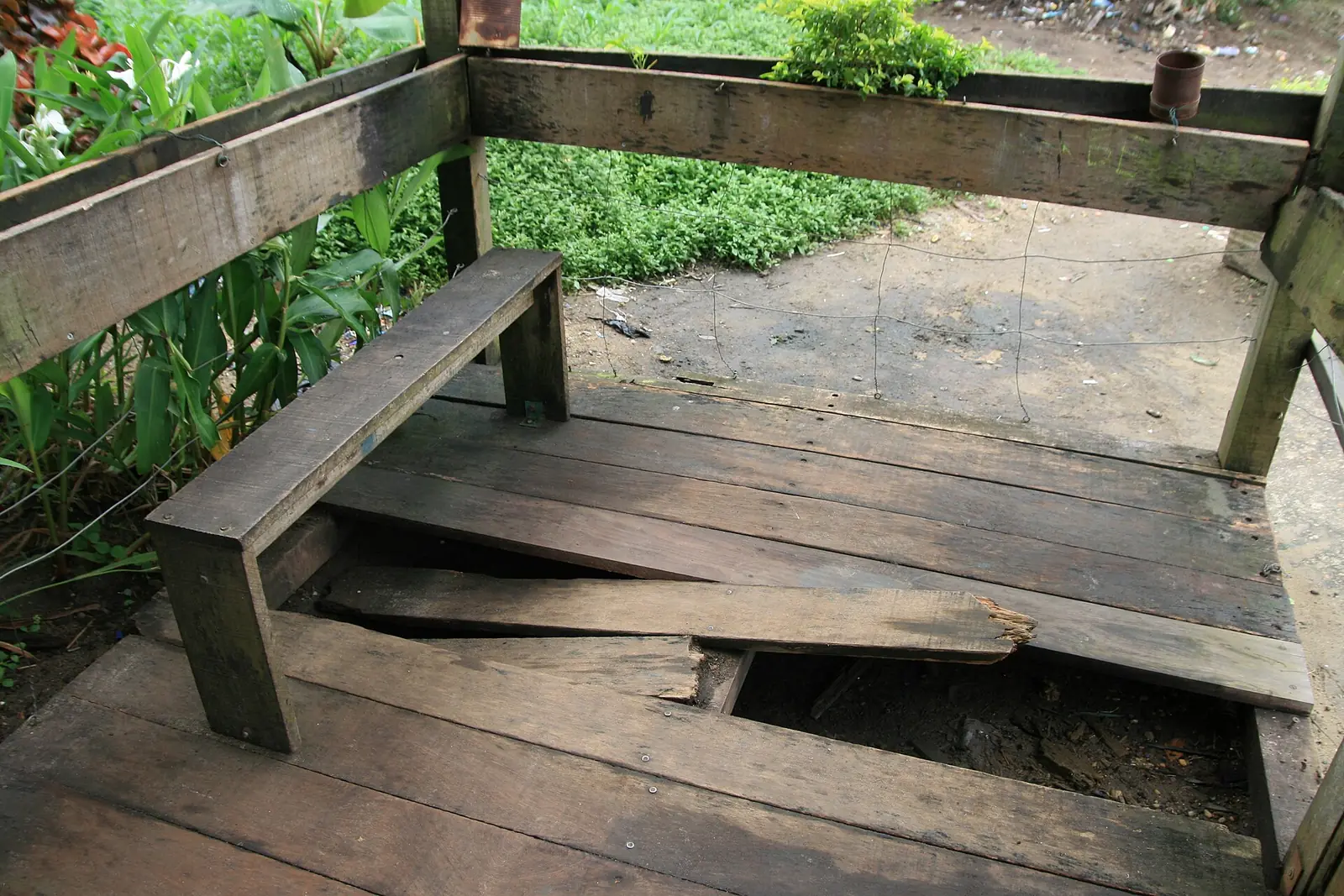
On the bank of the Wouri at Bonamouti, Lucas Grandin's sound garden is a three-level wooden structure that serves at once as a viewpoint over the river, a botanical garden and a percussion organ played by drops of water. English Wikipedia gives a height of 10 m, a length of 6.83 m and a width of up to 4.52 m, with 35 m² of floor over three levels of 20, 10 and 5 m².1,2
Rainwater is collected, stored in barrels and fed through transparent tubes to a vertical garden of flowers, spices, and cosmetic and medicinal plants, by a drip system that doual'art says can keep it watered for up to six months. The drops fall into tins of different sizes, sounding notes as they feed the plants.1
Built with the neighbourhood
Grandin began building in February 2010, for the second Salon urbain de Douala, SUD 2010, held from 4 to 11 December 2010 on the theme of water. The riverbank had been used as an unofficial dump. Through preparatory meetings, residents took part in clearing the site and building the structure; Grandin's own page names Hervé, Paul-Josué, Cédric, Tobie and Elie from Bonamouti among the builders, with help from Kamiel Verschuren and Xandra Nibbeling of Rotterdam. The work was sponsored by doual'art and given to the Communauté urbaine de Douala.1,9,3,10
Wood ages fast here. Pucciarelli wrote in 2014 that the garden had already been restored twice, by the artist and a Bonamouti team, and English Wikipedia dates repairs to 2012 and 2013. doual'art's appeal of November 2013 listed many planks to repair, the top-floor roof to redo, leaks to fix and the sounding tins to replace.4,2,5
How people use it
doual'art and Pucciarelli describe the garden as a place to rest and meet, with one of the few views Douala gives of its river and the mangrove, and a romantic spot where young couples climb to the upper floors. Pucciarelli notes that Bonamouti, known as Deïdo Plage, is one of the few districts with direct access to the Wouri, and that the cleared ground in front became a square where children play.1,4,3
Just below it on the bank, Salifou Lindou's Face à l'eau, also from SUD 2010, is a row of five panels of wood, metal and coloured plastic, the tallest 3.70 m high, set so that from a distance they read as one screen; it shields the canoe fishermen from passers-by when they wash after work.7,4
Is it still there?
The most recent dated account we found is from July 2017, when Doppiozero described the garden as frequented by fishermen in the morning and young people in the evening, and the old dump had not come back in seven years. OpenStreetMap maps it on rue Bonatéki in Bonamouti. Because it is built of wood and has needed regular repairs, check its state before going.6,8
Sources disagree on a few details. A Le Monde article quoted on Grandin's page describes a two-storey tower and calls the artist Belgian, while doual'art and Wikipedia describe three levels. English Wikipedia's map coordinates point well away from Bonamouti, so we use OpenStreetMap's.3,1,2,8
Map
What visitors say
We summarise accounts published elsewhere and link to the original. These aren't reviews collected by this site, and we don't show a rating.
They found a lawn kept clean around the structure, seven years after the dump was cleared, with fishermen using it in the morning and young people meeting there in the evening for shade, the river view and the sound of the drops.
Chiara Somajni and Iolanda Pensa, Doppiozero, July 2017
He called it a romantic place where people come to forget their worries, admitting that some residents could not see the point of climbing so high, but that for those who try to see a little further it is beautiful.
A regular visitor, quoted by Emmanuelle Lequeux in Le Monde (excerpt on the artist's page), Not stated
Check before you go
Our sources can't yet confirm these points:
- Whether the structure is still standing and safe to climb, and when it was last repaired
- Whether the drip system and sounding tins still work
- Who looks after it today
- Whether Face à l'eau is still on the bank
Also nearby
Sources for this page
Information checked on 18 November 2026. It may have changed since.
- Le Jardin Sonore, doual'art (undated)
- Le Jardin sonore, Wikipedia (English) (4 July 2026)
- Le Jardin Sonore de Bonamouti, Lucas Grandin, the artist's own site (undated)
- Douala Final Report (Mobile A2K, Culture and Safety in Africa), 2014, with fieldwork from December 2012 to January 2013, Marta Pucciarelli, SUPSI Laboratory of visual culture (archived copy) (undated)
- Douala Métamorphoses : patrimoine en péril !, doual'art, crowdfunding appeal on KissKissBankBank (closed 29 November 2013) (29 November 2013)
- Making Douala 2007-2017, Chiara Somajni and Iolanda Pensa, Doppiozero (14 July 2017)
- Face à l'eau, doual'art (undated)
- Le Jardin Sonore de Bonamouti, map feature looked up by us on 18 November 2026, OpenStreetMap Nominatim (undated)
- Festival SUD 2010, doual'art (undated)
- Liste des œuvres publiques de Douala, Wikipedia (French) (15 September 2026)
Enquire about Sound garden of Bonamouti
Visit Sound garden of Bonamouti
Plan your trip to Sound garden of Bonamouti in the Littoral Region. Send us an enquiry about guided tours, accommodation and transport, and we'll reply by email.
Send an enquiryLittoral Region
Capital: Douala
Cameroon's economic centre, around the port city of Douala and the Wouri Estuary, with Sawa and Bassa heritage, the Ngondo festival and the Sanaga River at Edéa.
More places in the Littoral Region
Douala Maritime Museum
A ship-shaped museum in Douala's Bonanjo district on Cameroon's coast, ports and ships, with a recreated ship's bridge and a navigation simulator.
La Pagode (Palace of King Bell)
The former palace of the Bell kings in Bonanjo, Douala, built in 1905 and still owned by the Bell family. It was home to Rudolf Duala Manga Bell, hanged by the German authorities in 1914.
Ekom-Nkam Waterfalls
A waterfall of about 80 m on the Nkam river near Melong, set in forest and used as a filming location for Greystoke (1984). A second fall runs beside it in the rainy season.
Wouri Estuary
The tidal estuary where the Wouri, Mungo and Dibamba meet the Atlantic at Douala, lined with mangroves and fishing villages, and the source of Cameroon's name.