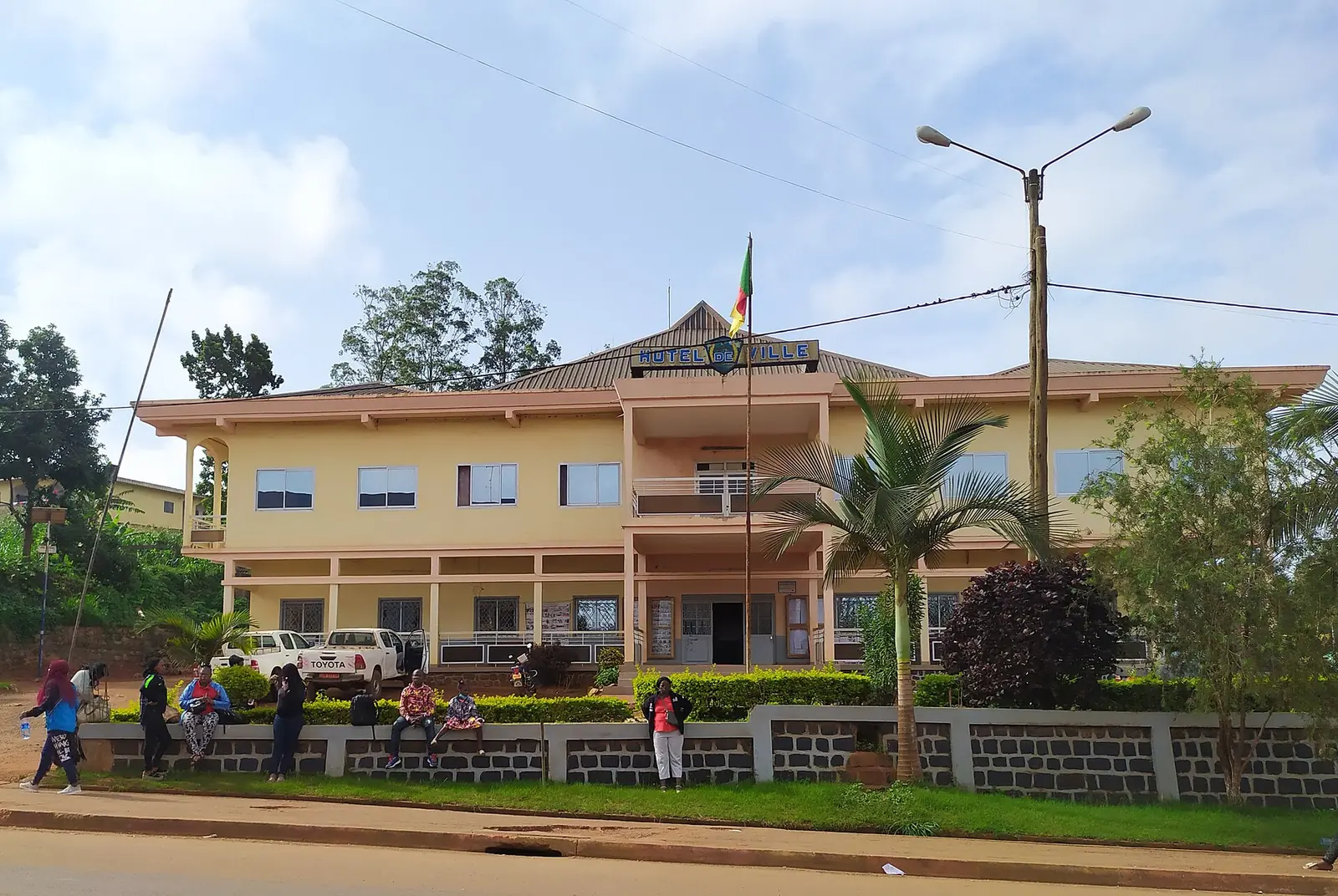
Menoua, the West division around Dschang: a cool highland town, the Djuttitsa tea estate, the Mamy Wata falls and the Mbo plain at Santchou.
Subdivisions of Menoua Division
Menoua Division has 6 subdivisions.
Dschang
Chief town: Dschang
Fokoué
Chief town: Fokoué
Fongo-Tongo
Chief town: Fongo-Tongo
Nkong-Ni
Chief town: Nkong-Zem
Penka-Michel
Chief town: Penka-Michel
Santchou
Chief town: Santchou
Places in Menoua Division
Where it is and what it's like
Menoua covers 1,380 km² in the west of the region, where the Bamiléké plateau drops to the Mbo plain. The statistics office places part of the division on the high plateaux and notes alluvial valleys and lowlands on the Mbo plain at Santchou. The Menoua river is a tributary of the Nkam. In the north, Nkong-Zem commune rises to Mount Meleta, 2,740 m, in the Bamboutos massif. Dschang stands at about 1,380 m, which gives it relatively cool temperatures.1,5,6
People
The 2005 census counted 285,764 people, against 251,616 in 1987; the 2010 projection was 296,603. Dschang subdivision had 101,385 people in 2005, Penka-Michel 65,135, Nkong-Ni 53,367, Santchou 37,479, Fongo-Tongo 18,822 and Fokoué 9,576. Dschang mainly speaks Yemba, a Bamiléké language. English Wikipedia describes Santchou as about 55% Bamiléké and 40% Mbo. The first-degree chiefdoms are Foto, at Dschang, and Bafou, in Nkong-Ni.1,2,7,8,9
History
A German military mission reached the area in 1895, on land disputed between the Foréké and Foto chiefdoms. Dschang became an administrative centre in the 1900s: French Wikipedia gives 1903, English Wikipedia 1909. Under French rule it was the capital of the region, with a holiday resort built in the 1940s, until the regional administration moved to Bafoussam at independence. In 1960 Menoua became one of the five departments carved from the former Bamiléké region. The University of Dschang opened in 1993.10,6,11,1
What it's known for
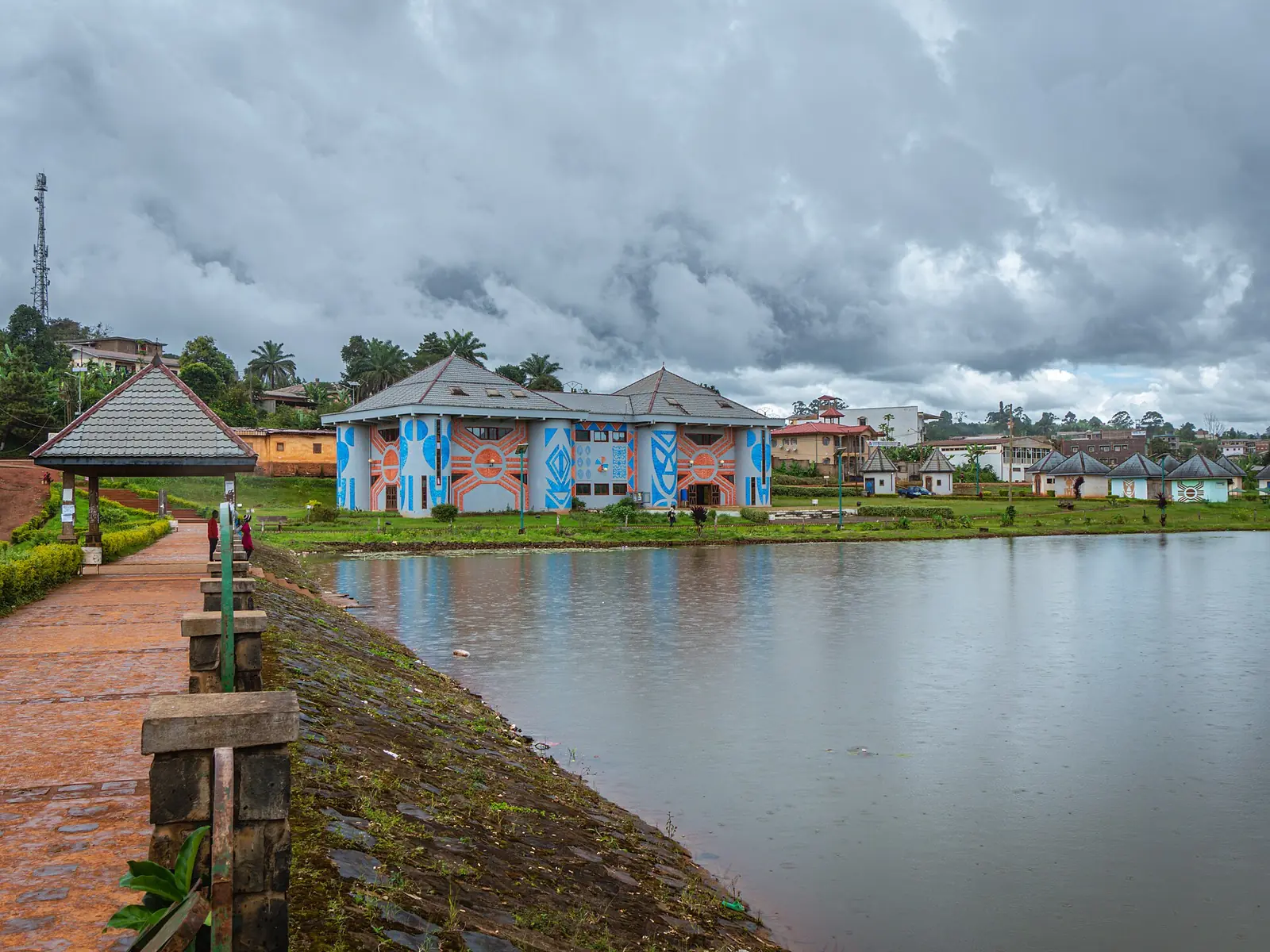
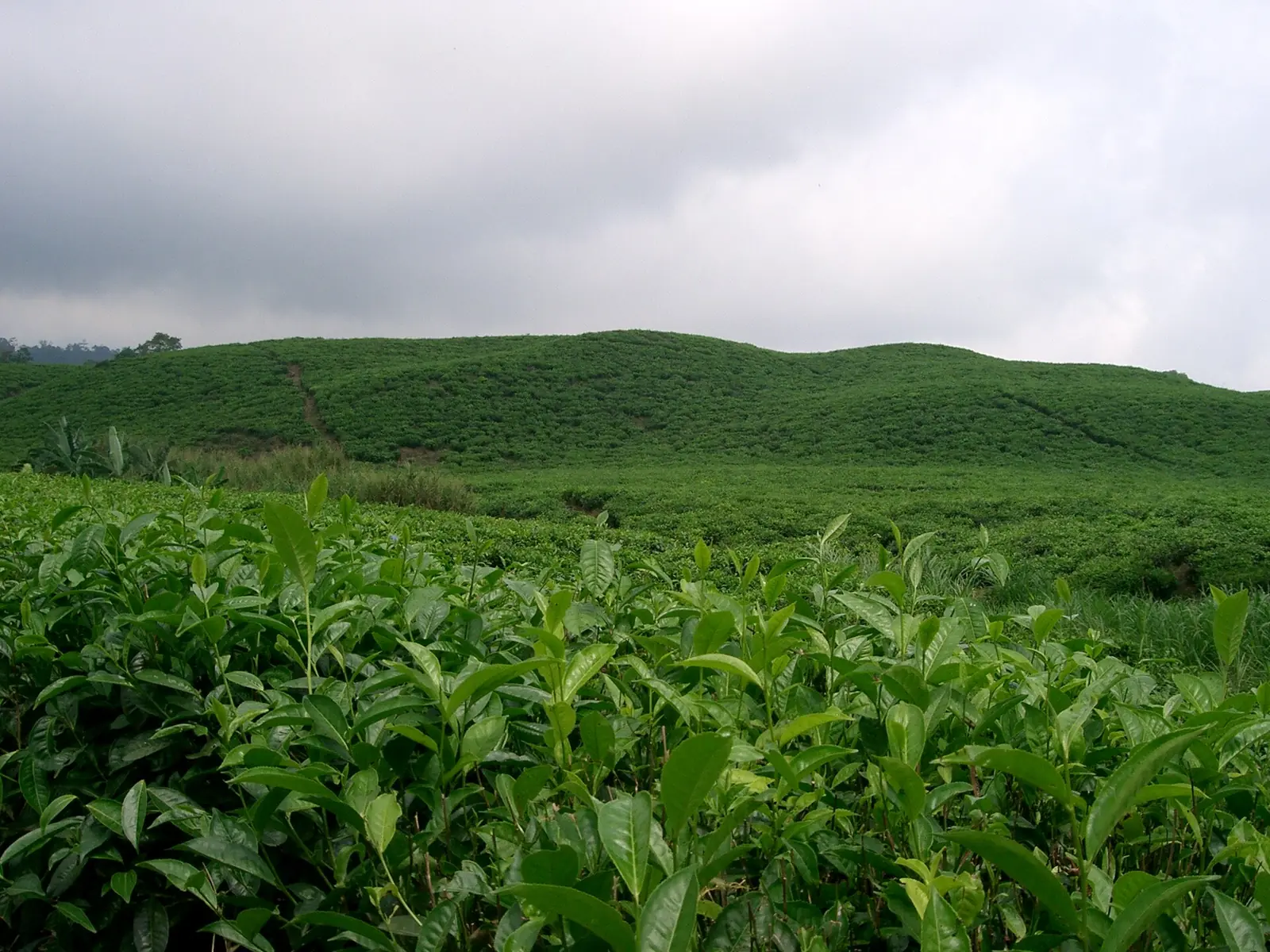
The site lists two places here. The Museum of Civilizations, beside Dschang's municipal lake, is in Dschang subdivision. The Djuttitsa tea estate is in Nkong-Ni subdivision, Nkong-Zem commune; French Wikipedia puts it at 1,800 m on volcanic soil, covering 1,660 ha. French Wikipedia also describes the Mamy Wata falls, 82 m high, at Fongo-Tongo about 24 km from Dschang, and the nearby Ndemvoh cave, a sacred site whose porch is 120 m wide.4,5,12,13
Main towns and getting there
Dschang is the West's second town after Bafoussam. It lies on provincial road P17, between Bamougoum on National Road 6 and Nkongsoung on National Road 5. Its distance from Bafoussam differs by source: French Wikipedia gives both 46 and 60 km, and the statistics office 50 km. French Wikipedia puts it about 300 km, or four hours, from Douala. By road from Bafoussam, Penka-Michel is 25 km, Nkong-Ni 43 km, Fongo-Tongo 63 km, Fokoué 70 km and Santchou 80 km.10,1
In pictures
Map
Still to confirm
Our sources can't yet confirm these points:
- The road distance from Bafoussam to Dschang (46, 50 or 60 km by source)
- The year Dschang became an administrative centre (1903 or 1909)
- The date the Nkong-Zem commune was created (1995 decree or 1996)
- The height of the Mamy Wata falls, given only by French Wikipedia
Sources for this page
Information checked on 19 November 2026. It may have changed since.
- Annuaire statistique de la région de l'Ouest, édition 2024: chapter 1 (relief, soils, rivers), Tableaux 1.1, 1.4, 2.1, 2.2 and 4.2 (sources: Governor's office, DR-MINTP, DR-ELECAM, BUCREP), Institut national de la statistique, Agence régionale de l'Ouest (undated)
- Cameroon: administrative division, census counts of 1987 and 2005 by division and arrondissement, City Population (Thomas Brinkhoff), citing BUCREP (19 November 2026)
- OpenStreetMap Nominatim: boundary relations of Menoua and its subdivisions (lookup), OpenStreetMap contributors / Nominatim (19 November 2026)
- OpenStreetMap: boundary of Dschang and Nkong-Zem communes, which contains the site's place coordinates (Overpass is_in query), OpenStreetMap contributors (19 November 2026)
- Nkong-Zem, Wikipédia (19 November 2026)
- Dschang, Wikipedia (19 November 2026)
- Yemba language, Wikipedia (19 November 2026)
- Santchou, Wikipedia (19 November 2026)
- Menoua (département), Wikipédia (19 November 2026)
- Dschang, Wikipédia (19 November 2026)
- Bamboutos, Wikipédia (19 November 2026)
- Chutes de Mamy Wata, Wikipédia (19 November 2026)
- Grotte Ndemvoh, Wikipédia (19 November 2026)