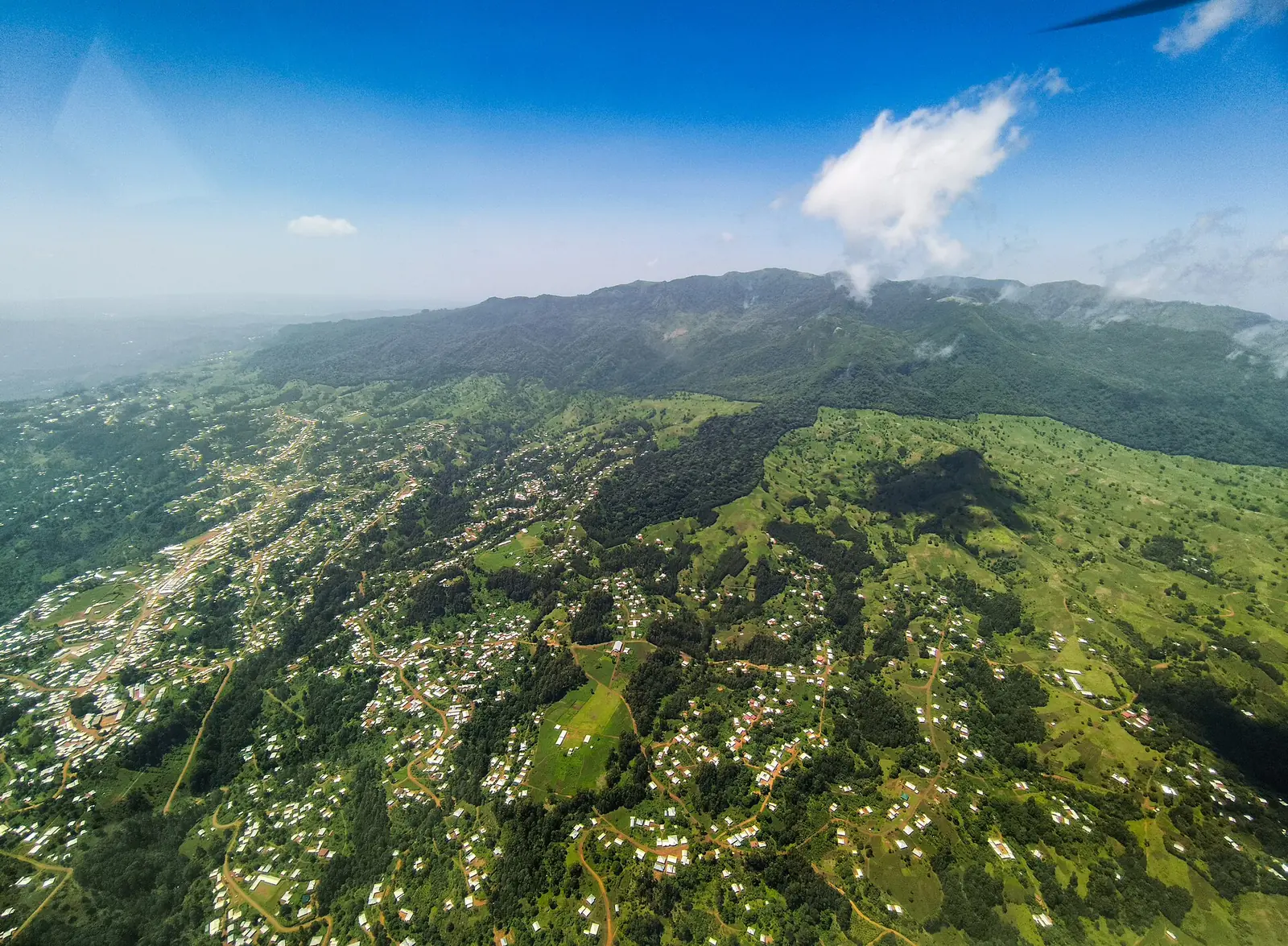
A white honey from a mountain forest
Oku white honey is a product, not a place: a creamy, crystallised honey made in the Kilum-Ijim forest around Mount Oku, in the Bamenda Highlands. A 2020 study describes its taste as sweet, mild and citrusy with a hint of smoke, and says it has been sold under its place of origin for at least a century. Honey from lower ground, below about 1,700 m, is brown.2
The colour is linked to the forest's flowers, notably Schefflera abyssinica and Nuxia congesta. WIPO counts more than 150 nectar plants in the forest, while beekeepers in the 2020 study named 123, of which 58 were forest plants and 65 were crops or exotic species. Some of these species flower only every few years, which makes the honey flow swing widely from one season to the next.1,2
How it is made
Most hives remain the traditional cylinders of bamboo, raffia and grass. WIPO describes hives being colonised with captured bees between September and April and moved into the forest between November and March. Yields are modest, about 5 kg per hive in 2017. WIPO puts forest beekeeping here at 150 years or more, passed down orally, and the 2020 study notes that honey and bees appear in local carvings, ceremonies and traditional medicine.1,2
The geographical indication
In 2013 the honey was registered as a geographical indication through the African Intellectual Property Organization (OAPI), in a pilot project with Penja pepper and Ziama-Macenta coffee, led by OAPI and CIRAD and funded by the French Development Agency. WIPO calls it a protected geographical indication, and the 2020 study also uses the term protected designation of origin. The largest producer is the Oku Honey Cooperative, founded in 1987 under a forest conservation project, with 216 members in the study.1,2
Results have been mixed. The study found that the cooperative's price for white honey rose 125% between 2008 and 2017, and that incomes improved, though it does not credit the label alone. Workloads and the cost of hive materials also rose. No trader used the official logo, and the association set up to run the label became less active after 2013. Sources also differ on exports: WIPO listed export channels in 2014, while the study says none of the honey had been officially exported.1,2
The forest behind the honey
Kilum-Ijim is a montane cloud forest on the slopes of Mount Oku, whose peak reaches 3,011 m. Sources measure it differently: about 200 km² in the 2020 study, over 20,000 hectares in WIPO, and 163.53 km² for the Key Biodiversity Area, which says about half of the enclosed land is forest. The study records a 62% fall in forest cover between 1978 and 2001, leaving 8,122 hectares, and concludes that the label has not been enough to stop the loss.1,2,3
Fire is a recurring problem for beekeepers. A bushfire that began on 22 February 2026 in the Nchiiy community forest, near Mbohkeghas village, destroyed hives belonging to several producers and scorched regenerating woodland, according to the local outlet Hilltop Voices. More than 40 bee farmers were among the first to respond. The report gives no count of hives lost.2,4
Map
Still to confirm
Our sources can't yet confirm these points:
- The legal form of the label: WIPO says protected geographical indication and the 2020 study also says protected designation of origin. The OAPI register was not read.
- Production since 2014, and the number of producers now working under the label.
- How many hives the February 2026 fire destroyed.
Sources for this page
Information checked on 6 November 2026. It may have changed since.
- Bees, Geographical Indications, and Development, World Intellectual Property Organization (24 November 2014)
- To Label or Not? Governing the Costs and Benefits of Geographic Indication of an African Forest Honey Value Chain (Ingram, Hansen and Bosselmann), Frontiers in Forests and Global Change (10 September 2020)
- Mount Oku (6115), Key Biodiversity Areas Partnership (2024)
- Fire at Kilum–Ijim leaves livelihoods exposed, tests community conservation resolve, Hilltop Voices (26 February 2026)
Northwest Region
Capital: Bamenda
A highland region of grassland, volcanic peaks and crater lakes, with Bamenda as its capital and Fons at the head of its many chiefdoms.
More places in the Northwest Region
Lake Oku
A crater lake on Mount Oku, ringed by montane forest and sacred to the Oku people. It is the only known home of the Lake Oku clawed frog.
Bafut Palace
The seat of the Fon of Bafut, a compound of about 50 buildings around a thatched shrine, beside a sacred forest, rebuilt after the German wars of the early 1900s and on UNESCO's Tentative List.
Big Babanki (Kejom Keku)
Big Babanki, or Kejom Keku, is a Kejom-speaking fondom in the Bamenda Highlands, near patches of montane forest rich in birds found only in the Cameroon mountains.
Lake Nyos
A deep crater lake in Cameroon's Grassfields, studied by scientists for its dissolved gas and the pipes built to draw it from the depths.