- Location
- Mezam department, Northwest Region1
- Birds in nearby forest
- 109 species (2003 and 2005 surveys)3
A Kejom-speaking village
Big Babanki, Kejom Keku in the local language, is one of the two main settlements where Kejom, better known as Babanki, is spoken. The other is Kejom Ketinguh, or Babanki Tungoh. Both are in Mezam department, in the Northwest Region. A 2021 map of the language area places Kejom Keku to the north, separated from Kejom Ketinguh and nearby Bambili by a sparsely populated stretch.1,2
Kejom is a Central Ring Grassfields Bantu language. The two settlements' dialects differ slightly but are mutually intelligible, and some speakers in Kejom Keku also speak Kom, the neighbouring Ring language. Cameroonian Pidgin English is increasingly used in all settings, even at home. Ethnologue gave 39,000 speakers in 2011, which the Endangered Languages Project says reflects the ethnic population, with about 20,000 actual speakers. An orthography is used in literacy classes in both settlements and in an ongoing Bible translation.1,2
Fon and palace carving
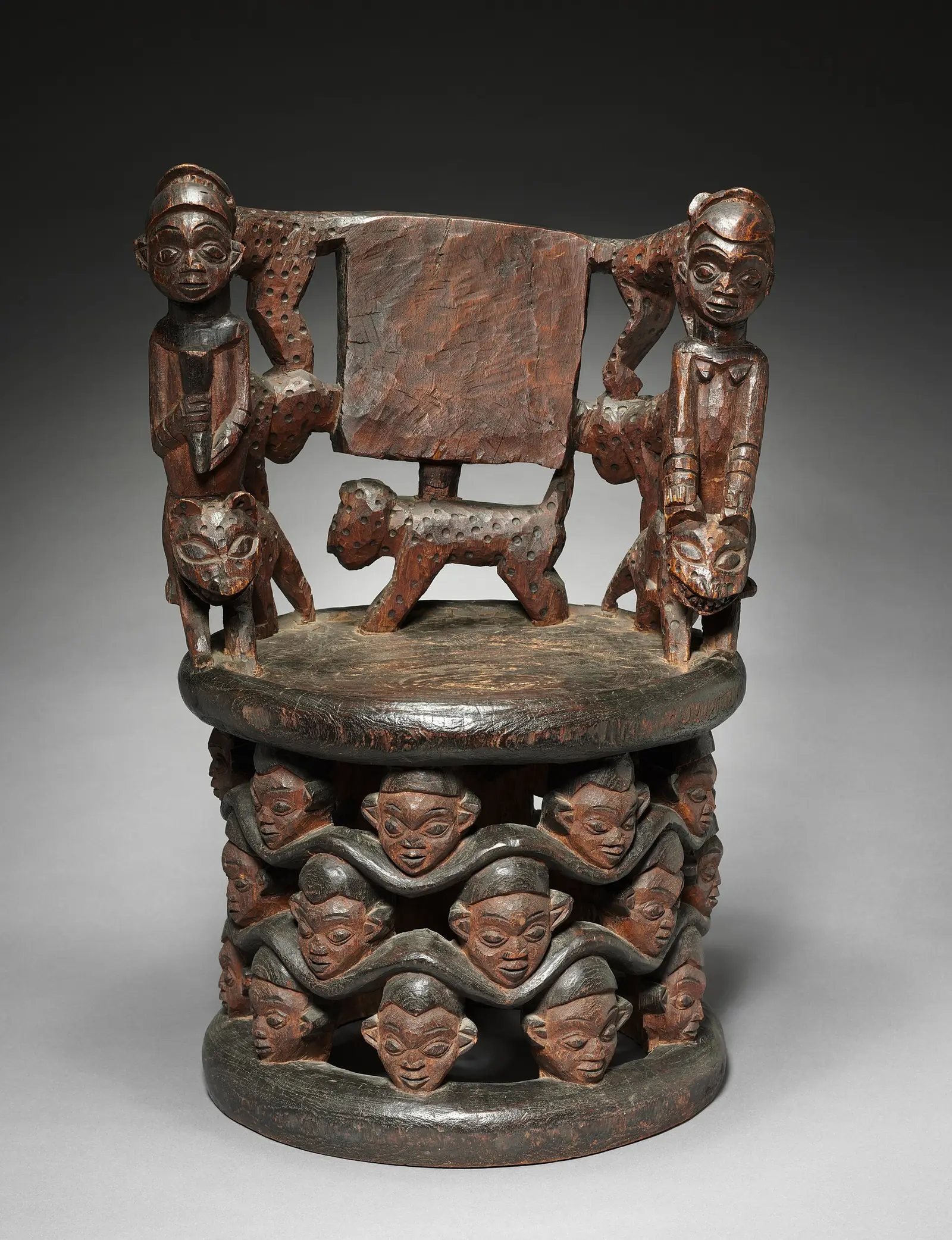
Big Babanki is a fondom, led by a fon. The Basel Mission Archives hold a 12-page text from 1983 by Hans Knöpfli titled 'A new Fon of Kedjom Keku (Big Babanki) in the grassfields of Cameroon'. The Metropolitan Museum of Art in New York holds three carved palace pieces it attributes to Big Babanki: a pillar with female figures, a pillar with male figures and a leopard, and a lintel with leopards. Each is about 2.46 m tall, made of wood and pigment, dated to the late 19th or early 20th century, and credited to a Grassfields artist; the museum acquired them in 1972.4,5,6,7
Montane forest near the village
Czech ornithologists surveyed an unprotected mosaic of montane forest and grassland near Big Babanki and Kedjom-Keku from November to December 2003, and again in late 2005. The area, part of the Mount Oku massif at about 2,200 m, lies 21 km northeast of Bamenda, 27 km southwest of Mount Oku and 5 km west of Mbi crater. It covers about 1 km² of grassland, pasture, fields and stream-side woodland, with two forest patches of about 20 ha together.3
They recorded 109 bird species, including 12 found only in the Cameroon mountains, such as Bannerman's turaco, which was fairly common there, and the banded wattle-eye. They also saw the great blue turaco, considered extinct on Mount Oku, and Cameroon's first recorded red kite. Some forest specialists, such as the bar-tailed trogon, were missing, which the authors linked to fragmentation. They named grazing, wood cutting and farming as pressures on the forest, and dry-season bush fires as the most damaging.3
Map
Still to confirm
Our sources can't yet confirm these points:
- The history of the fondom and its line of fons; no study read covers it.
- The village's population; only language-wide figures were found.
- The Metropolitan Museum's own catalogue text on the palace pieces, which a search summary links to a 1933 palace renovation and to missionary Paul Gebauer; the page refused the fetch, so only the collection data was read.
- That the OpenStreetMap point named 'Babanki' is Big Babanki and not another part of the area.
Sources for this page
Information checked on 9 November 2026. It may have changed since.
- Babanki language, Wikipedia (citing Ethnologue, the Endangered Languages Project and Akumbu) (undated)
- Kejom (Babanki) (M. Faytak and P. W. Akumbu), Illustrations of the IPA, Journal of the International Phonetic Association 51(2), Cambridge University Press (2021 (online 2020-02-24))
- The birds of a montane forest mosaic in Big Babanki area, Bamenda Highlands, Cameroon (O. Sedláček et al.), Malimbus 29, West African Ornithological Society (2007)
- Palace pillar with female figures (1972.4.29a), collection record, The Metropolitan Museum of Art (Record updated 2025-10-31)
- Palace pillar with male figures and leopard (1972.4.29b), collection record, The Metropolitan Museum of Art (Record updated 2025-10-31)
- Palace lintel with leopards (1972.4.29c), collection record, The Metropolitan Museum of Art (Record updated 2025-10-31)
- A new Fon of Kedjom Keku (Big Babanki) in the grassfields of Cameroon (Hans Knöpfli), catalogue record, Basel Mission Archives / Mission 21 (1983)
Northwest Region
Capital: Bamenda
A highland region of grassland, volcanic peaks and crater lakes, with Bamenda as its capital and Fons at the head of its many chiefdoms.
More places in the Northwest Region
Lake Oku
A crater lake on Mount Oku, ringed by montane forest and sacred to the Oku people. It is the only known home of the Lake Oku clawed frog.
Bafut Palace
The seat of the Fon of Bafut, a compound of about 50 buildings around a thatched shrine, beside a sacred forest, rebuilt after the German wars of the early 1900s and on UNESCO's Tentative List.
Lake Nyos
A deep crater lake in Cameroon's Grassfields, studied by scientists for its dissolved gas and the pipes built to draw it from the depths.
Mankon Museum
A palace museum at the gate of Mankon Palace in Bamenda, showing objects of kingship, belief and daily life, some of which still leave for ceremonies.