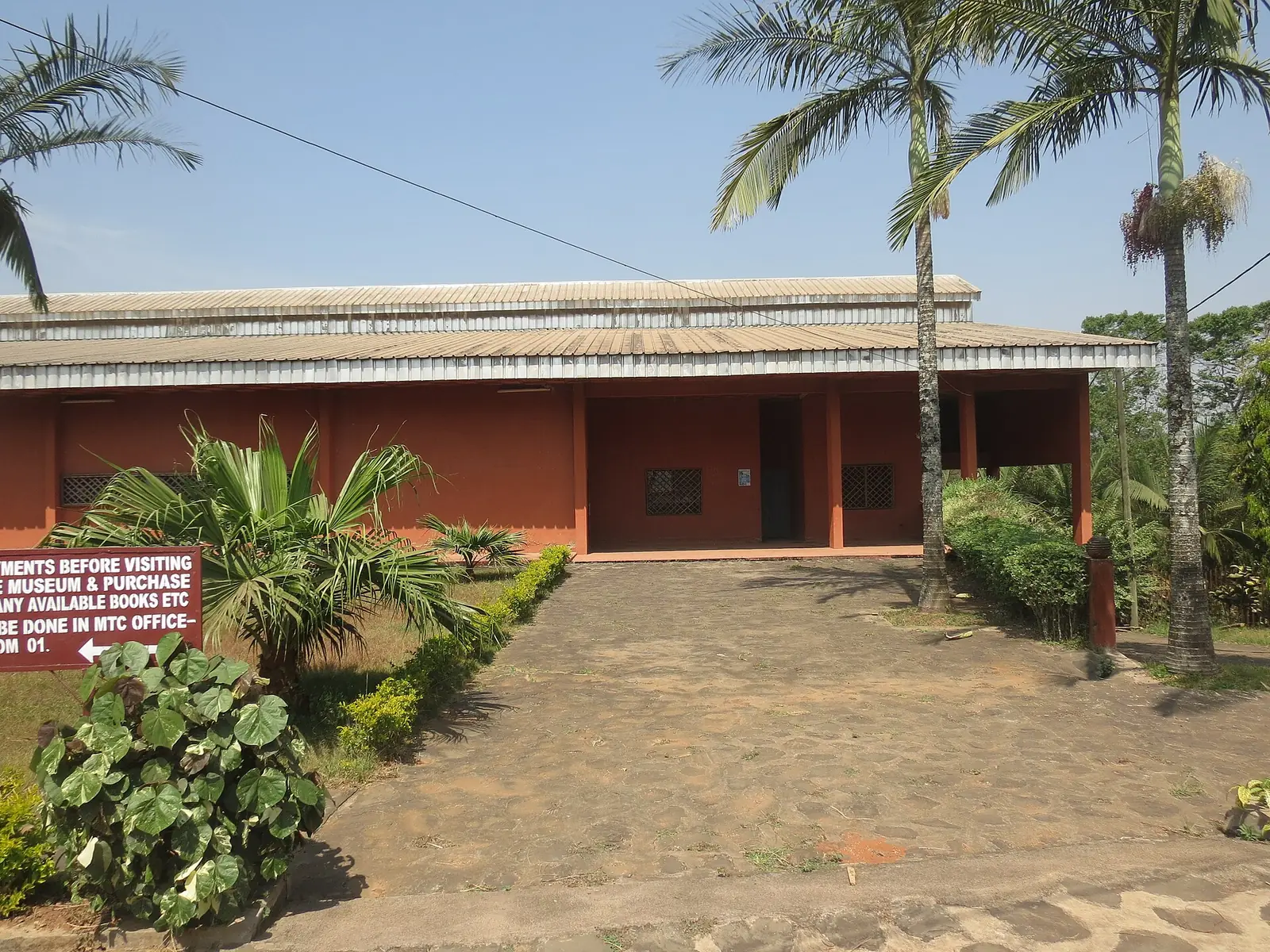
- Permanent exhibition
- About 179 objects in six sections4
A museum at the palace gate
The Mankon Museum stands at the entrance to the palace of the Fon of Mankon, a Grassfields kingdom on the outskirts of Bamenda. The kingdom's own catalogue claims a population of 50,000 to 70,000. Fon Angwafo III, the twentieth fon, reigned from 1959 until his death on 21 May 2022, and his son Fru Asaah Angwafo IV succeeded him on 7 June 2022.1,6,7
The museum came out of a project by the Italian NGO Centro Orientamento Educativo to protect Grassfields art and heritage in its original setting. Architect Bianca Triaca managed it and art historian Jean-Paul Notué directed the research. Five kingdoms were chosen from nearly two hundred, and four young people from each trained as curators over two years. Wikipedia and a page derived from similar text give 2006 as the inauguration; the catalogue is dated 2006 by one scholar and 2005 by another.1,2,3,4
The two-storey building was put up for the project, with labour and materials from the palace and the community. The museum occupies the upper floor. When Erica Jones did her research there around 2011 and 2012, the floor below, once a library, exhibition space and store, had been abandoned.1
What the collection holds
The permanent exhibition, Arts, Heritage and Culture from the Mankon Kingdom, is described as about 179 objects in six themed sections. Jones writes that Mankon has no single speciality, so the collection shows the usual holdings of a Grassfields kingdom: objects tied to kingship, religion and daily life. They include beaded headdresses, masks and a dance costume covered in locks of hair. Most COE museum pieces came from palace storerooms, though Mankon's displays also draw on the wider community.1,4
Curators call these living museums, because objects can leave for the ceremonies they were made for. People with a legitimate tie to an object, usually donors, their families or palace members, may borrow it and sign it out. Ankle rattles have gone out for a masquerade when the palace ran short, and a prince's masquerade costume is blessed at the palace before each use. A visitor's blog from 2016 also mentions a gossip bag, passed from person to person until it reached the one who started the rumour.1,8
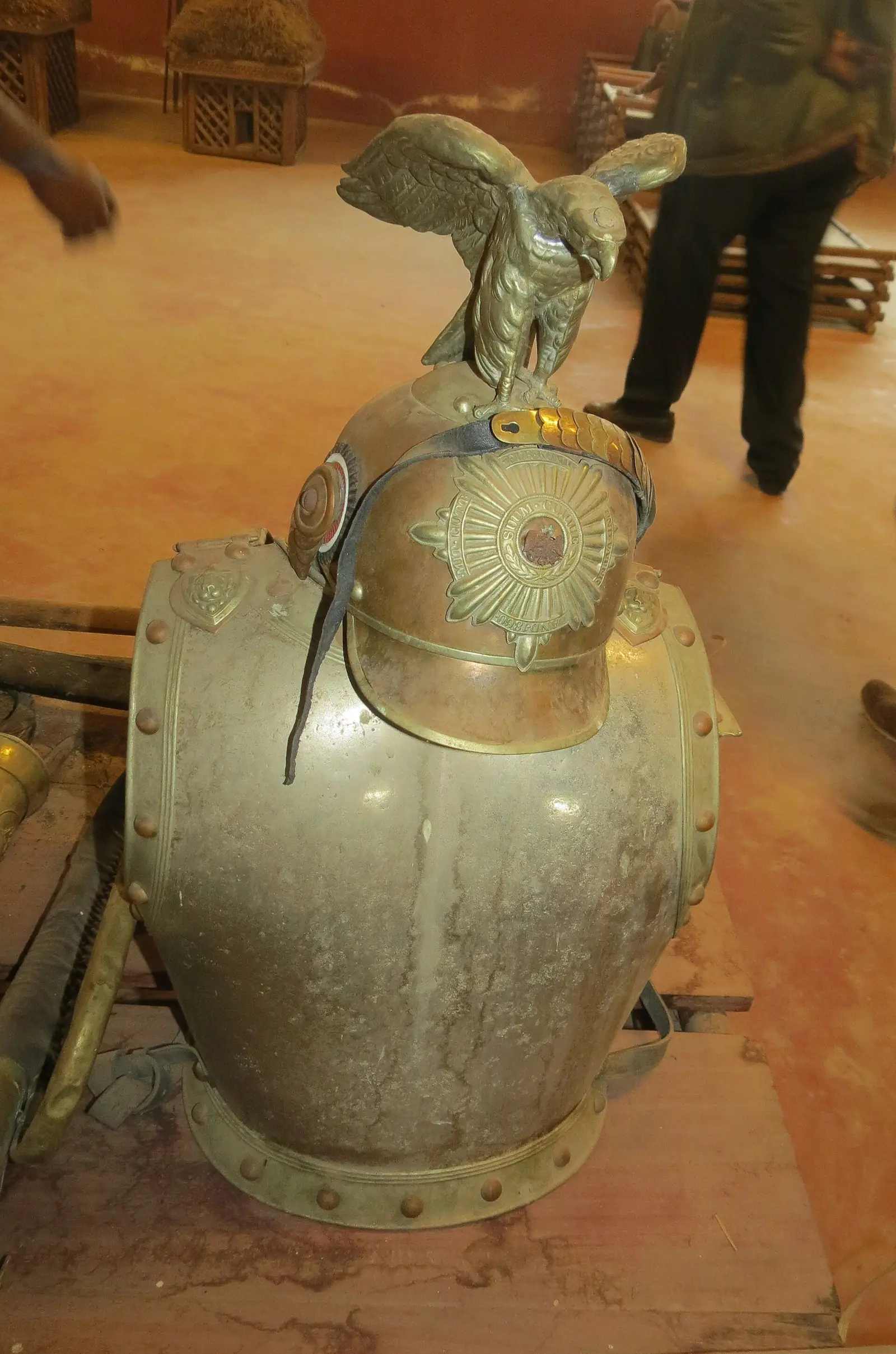
The Fon's German armour
One piece holds a contested story. Jones traces the German breastplate and cuirassier helmet to a conflict that began when the explorer Eugen Zintgraff entered the region. At the Battle of Mankon on 31 January 1891, parts of Mankon burned, four of his German companions died, and many Mankon and Bafut men were killed or captured. A German punitive expedition defeated Mankon and Bafut in 1901, and Fon Angwafo II received the armour in 1902 as a gift from Kaiser Wilhelm II. Historian E. M. Chilver reads it as a token given after defeat. The museum tells the battle as a Mankon victory, and the Fon has worn the armour at public celebrations as a sign of prestige.1
A debated account of the past
Scholars have asked whose history the museum tells. Anthropologist Michael Rowlands, cited by Jones, argues that it places the palace and the king at the centre of Mankon identity and leaves out readings that challenge the ruler. Views on the display itself also differ. Wikipedia, citing Mathias Fubah, reports that showing objects not meant for general view upset some residents, while Jones heard of no objection to having a museum at Mankon.1,3,5
In pictures
Map
Still to confirm
Our sources can't yet confirm these points:
- The 2006 inauguration date: it appears on Wikipedia and in text that closely follows it, and Jones's dissertation does not state it. The project's own site, museumcam.org, returned an error when checked.
- The figure of about 179 objects in six sections comes from a general page on Cameroon's museums, not from the catalogue itself.
- Whether the armour and other pieces listed here are still in the collection, and whether the lower floor is still unused.
Sources for this page
Information checked on 6 November 2026. It may have changed since.
- The Multiple Lives of Objects: Museum, Memory, and Modernity in the Cameroon Grassfields (PhD dissertation, Erica Perlmutter Jones), University of California, Los Angeles (2014)
- Do We Need Museums in the Cameroon Grassfields? (Mathias Alubafi Fubah; extract and references read), African Research and Documentation, Cambridge University Press (2013)
- Mankon Museum, Wikipedia (undated)
- Museums of Cameroon, Africa.com (28 June 2022)
- Blog post by Erica P. Jones on Grassfields palace museums, boasblogs (14 July 2019)
- Mankon, Wikipedia (undated)
- Fon Angwafo III of Mankon, Wikipedia (undated)
- Mankon and Bamendjinda (personal travel blog), The Guppy Went With Gusto (17 September 2016)
Northwest Region
Capital: Bamenda
A highland region of grassland, volcanic peaks and crater lakes, with Bamenda as its capital and Fons at the head of its many chiefdoms.
More places in the Northwest Region
Lake Oku
A crater lake on Mount Oku, ringed by montane forest and sacred to the Oku people. It is the only known home of the Lake Oku clawed frog.
Bafut Palace
The seat of the Fon of Bafut, a compound of about 50 buildings around a thatched shrine, beside a sacred forest, rebuilt after the German wars of the early 1900s and on UNESCO's Tentative List.
Big Babanki (Kejom Keku)
Big Babanki, or Kejom Keku, is a Kejom-speaking fondom in the Bamenda Highlands, near patches of montane forest rich in birds found only in the Cameroon mountains.
Lake Nyos
A deep crater lake in Cameroon's Grassfields, studied by scientists for its dissolved gas and the pipes built to draw it from the depths.