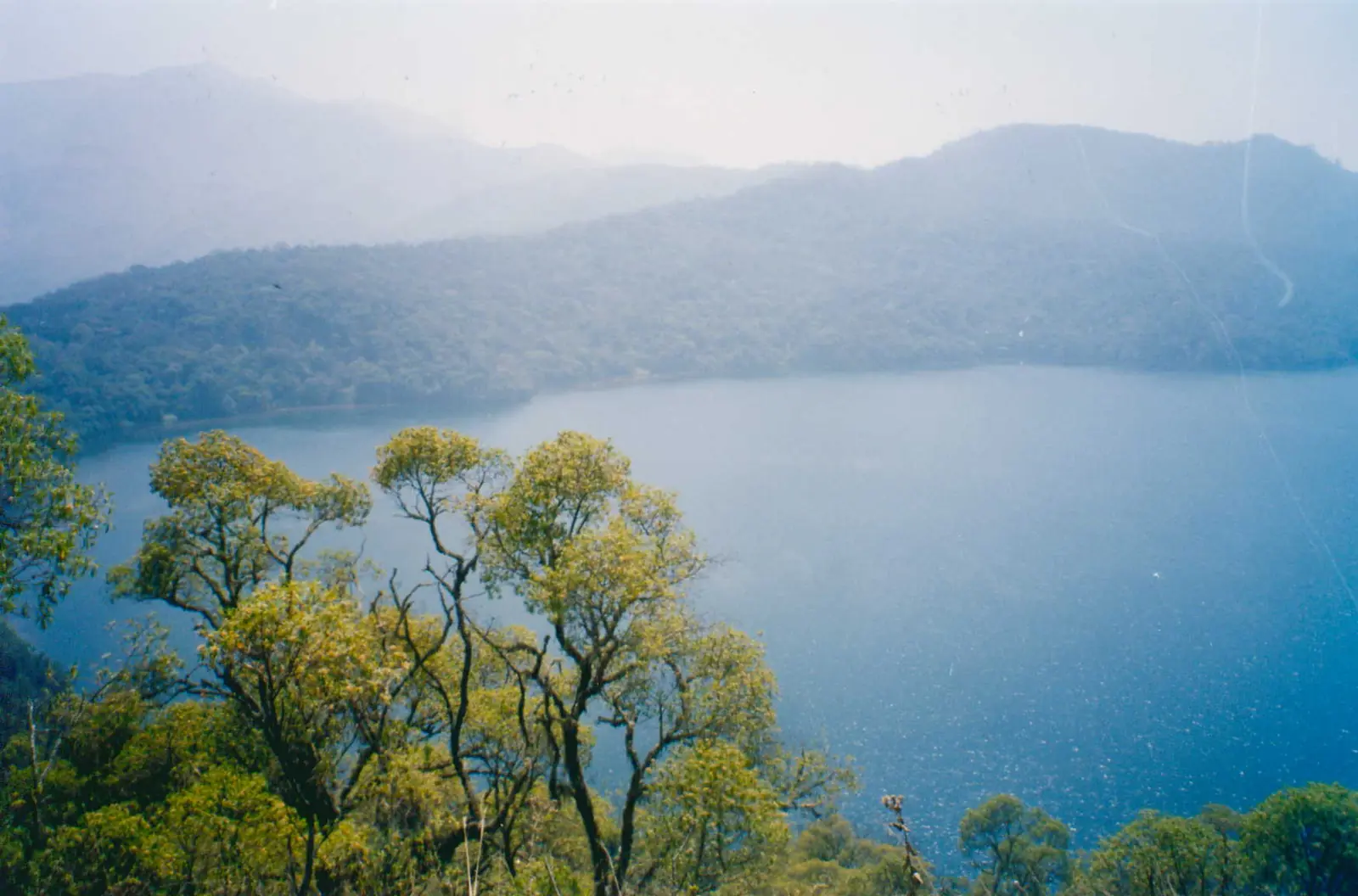
A crater lake in the Oku forest
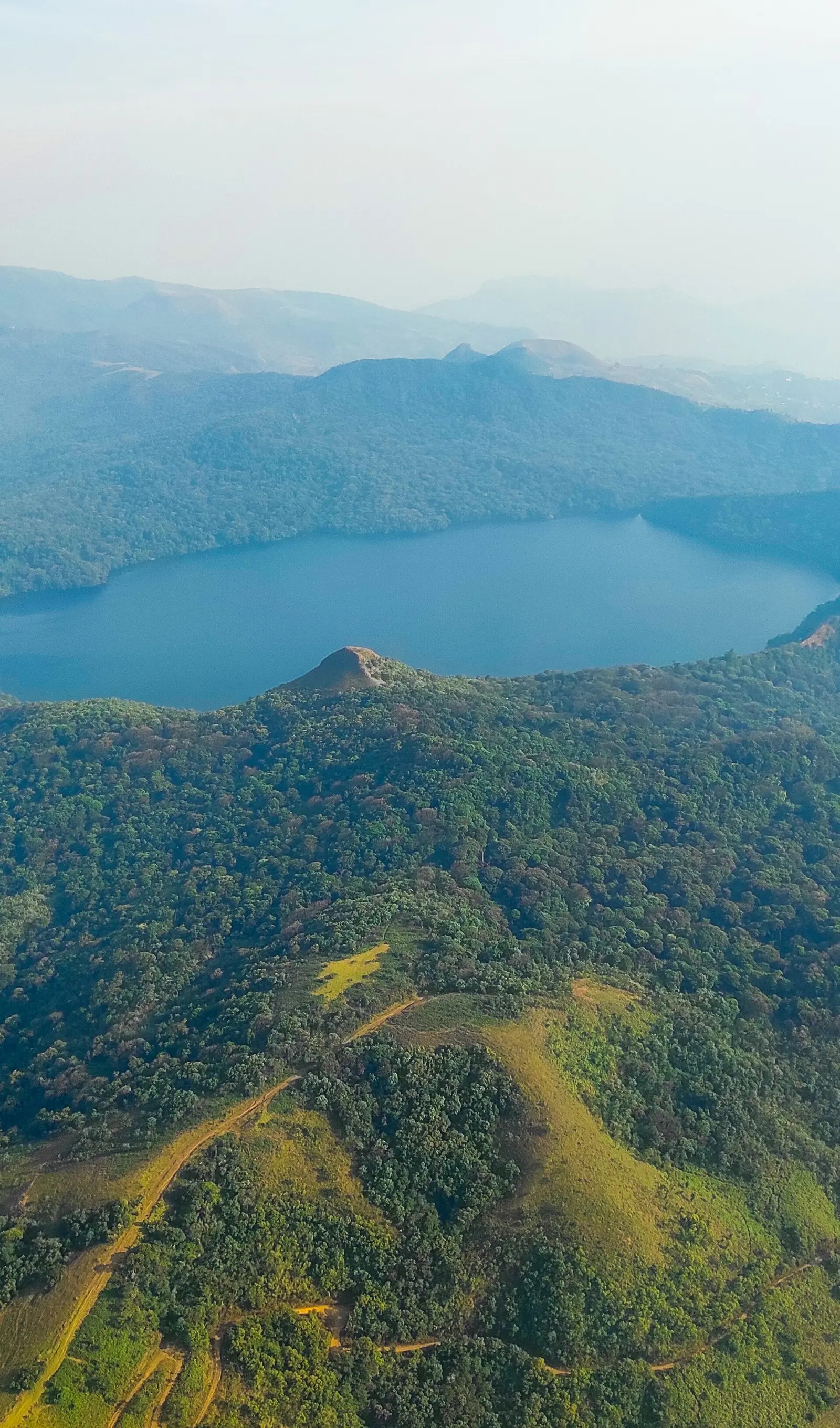
Lake Oku lies in a crater on Mount Oku, a 3,011 m peak, on the Bamenda Plateau in Cameroon's Northwest Region. Forest surrounds it entirely, and a thin belt of that forest forms a government plant sanctuary of about 500 hectares. No settlements stand around the shore.1,7
Measurements vary. The Key Biodiversity Areas factsheet gives an altitude of about 2,200 m, ERuDeF says 2,227 m, and a 2008 EDGE post says 2,392 m. The lake covers about 243 hectares with a shoreline of about 5 km, and its diameter is given as about 2,000 m. Its mean depth is reported as 32 m, and Wikipedia gives a greatest depth of 52 m. Monthly readings from the shoreline showed a mean water temperature near 17 °C.1,2,4,5,7,9
A sacred lake and its origin story
The Oku villages consider the lake sacred, and researchers collecting frogs in 2008 had to get permission before any contact with it. In a version of its origin story recorded in Oku in 2017, a weary stranger asks the Oku chief for land and is shown the spot where the lake now lies. He warns the children who gave him food to climb a hill when the rain comes, and those who refused drown in the flood that forms the lake. The Oku and the Kejem (Babanki) then dispute ownership, and it is the Oku chief who comes back from the water, in a white feathered cap. The storyteller says the chief of Oku still goes to the lake every year to perform rituals and offer sacrifices.2,4,6
The Lake Oku clawed frog
The lake's best-known resident is Xenopus longipes, a small, fully aquatic frog of 28 to 36 mm, described by science in 1991 and found nowhere else. It is listed as Critically Endangered because its whole range is one lake. It is also unusual genetically: it is dodecaploid, with 12 sets of chromosomes. A 2008 post from the EDGE programme described the lake as apparently without fish, which is why the possible introduction of fish worries researchers.2,3,4,5,7
Between 2006 and 2010, researchers repeatedly found large numbers of dead and diseased frogs around the shore. Tests for chytrid fungus were negative, only 1 of 48 diseased samples was positive for ranavirus, and the cause remains unknown. As a precaution, captive colonies were set up in 2008 at Antwerp Zoo and at ZSL London Zoo, and later at the Steinhart Aquarium in the United States, and ZSL has reported breeding the species.2,3
Protection and pressures
Sources describe the lake's protection differently. ERuDeF says the lake itself has no specific protection beyond the forest sanctuary and community management, while EDGE describes a government-sanctioned protected area around the lake and forest, with enforcement that is complex and contested. The wider Mount Oku site holds the entire known populations of five amphibian species, including this frog, and three mammals. A Rufford Foundation project due to run from June 2026 to June 2027 cites farming, shoreline grazing, murkier water and lost shoreline plants as pressures, and plans to train 20 to 30 residents as monitors with the Oku Traditional Council.1,5,7,8
In pictures
Map
Still to confirm
Our sources can't yet confirm these points:
- The lake's exact altitude, since sources range from about 2,200 m to 2,392 m.
- Whether fish have been introduced: EDGE's species page lists introduced fish among threats, while other sources treat it as a possibility.
- The frog's current IUCN status: the Red List page could not be opened, so this rests on Michaels et al. (2015), ERuDeF (2020) and the Rufford Foundation (2026).
- The lake's age: no remaining source dates it.
- The legal status of the lake and forest today.
- The greatest depth of 52 m rests on Wikipedia alone among the sources cited here.
Sources for this page
Information checked on 6 November 2026. It may have changed since.
- Mount Oku (6115), Key Biodiversity Areas Partnership (2024)
- Breeding and rearing the Critically Endangered Lake Oku Clawed Frog (Michaels et al.), Amphibian & Reptile Conservation 9(2), Amphibian & Reptile Conservation (2015)
- Morbidity and mortality of the Critically Endangered Lake Oku clawed frog Xenopus longipes (Doherty-Bone et al.), abstract read, Endangered Species Research 21: 115-128 (2013)
- Introducing the Lake Oku clawed frog, EDGE of Existence, Zoological Society of London (12 November 2008)
- Lake Oku clawed frog, EDGE of Existence, Zoological Society of London (undated)
- Lake Oku myth, told by Peter Mkong Bongjio, entry by Divine Che Neba, Our Mythical Childhood Survey, University of Warsaw (recorded 2017-11-05)
- Lake Oku: home to the endemic clawed frog Xenopus longipes, Environment and Rural Development Foundation (ERuDeF) (30 April 2020)
- Community-led conservation of the Critically Endangered Lake Oku clawed frog through habitat protection, The Rufford Foundation (1 May 2026)
- Lake Oku, Wikipedia (undated)
Northwest Region
Capital: Bamenda
A highland region of grassland, volcanic peaks and crater lakes, with Bamenda as its capital and Fons at the head of its many chiefdoms.
More places in the Northwest Region
Bafut Palace
The seat of the Fon of Bafut, a compound of about 50 buildings around a thatched shrine, beside a sacred forest, rebuilt after the German wars of the early 1900s and on UNESCO's Tentative List.
Big Babanki (Kejom Keku)
Big Babanki, or Kejom Keku, is a Kejom-speaking fondom in the Bamenda Highlands, near patches of montane forest rich in birds found only in the Cameroon mountains.
Lake Nyos
A deep crater lake in Cameroon's Grassfields, studied by scientists for its dissolved gas and the pipes built to draw it from the depths.
Mankon Museum
A palace museum at the gate of Mankon Palace in Bamenda, showing objects of kingship, belief and daily life, some of which still leave for ceremonies.