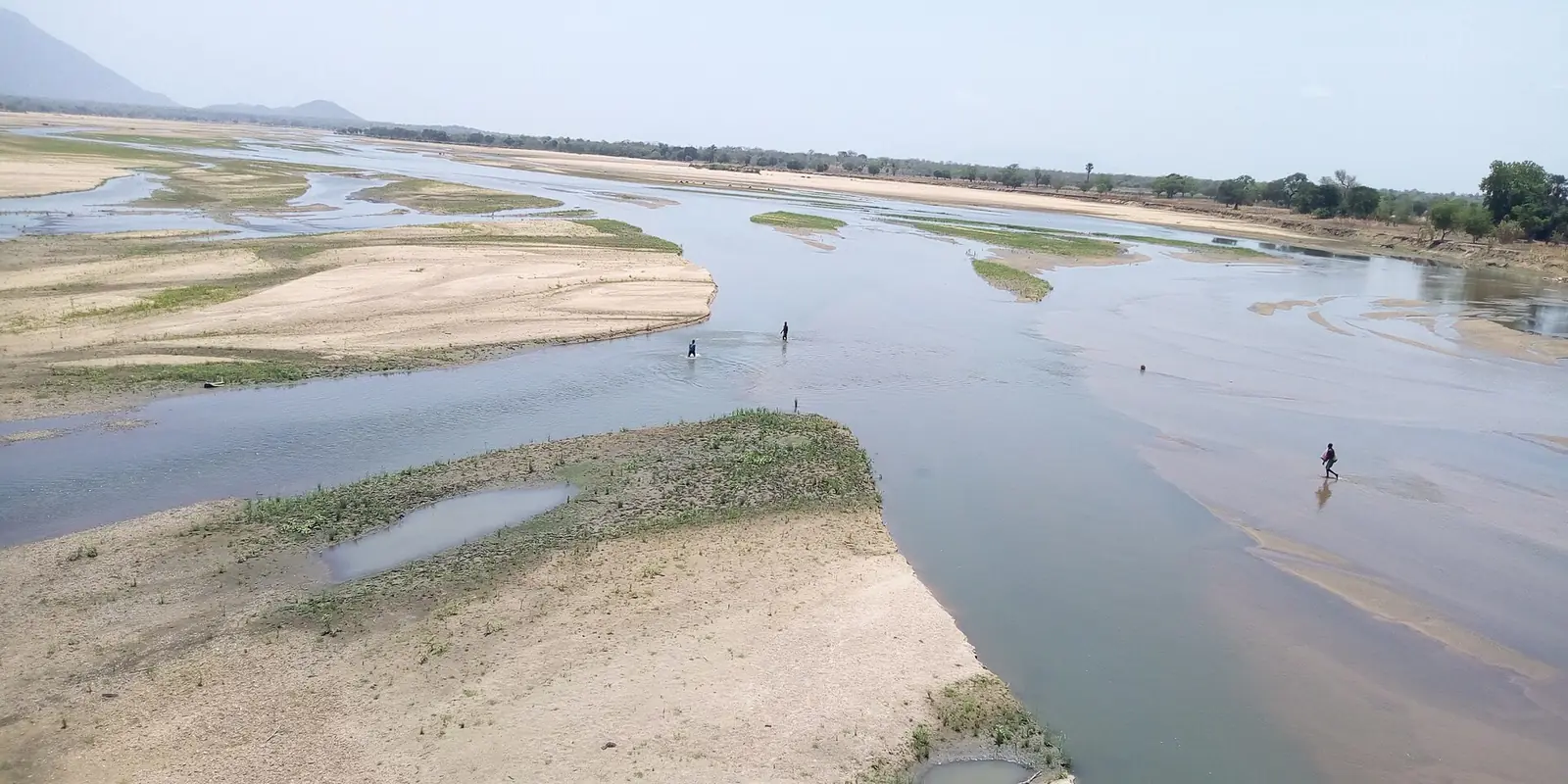
Savanna between two rivers
Faro National Park lies in the west of the North Region, close to the Nigerian border, and belongs to a wider landscape that includes Nigeria's Gashaka Gumti National Park. It began as a faunal reserve in 1947 and became a national park in 1980. Sources give an area between 3,300 and 3,418 km². One 2025 African Wildlife Foundation article places it in Adamawa, but the foundation's own 2022 notice and other sources say the North Region.1,2,3,4,6,7,9
The land is gently rolling at 250 to 500 m, with a few rocky hills reaching about 1,000 m. Tall Isoberlinia woodland in the south gives way to lower woodland and wooded grassland in the north, with dry riverside forest along the Faro. The Faro and Déo are seasonal, and sandbars appear in the dry season.1
Wildlife
A survey in March 2025 by the African Wildlife Foundation and the Garoua Wildlife School recorded 34 species of large and medium-sized mammals. Buffon's kob was the most often seen, with an estimated 4,673 animals, and Derby eland, roan antelope, harnessed bushbuck and buffalo were also noted. Giraffes and elephants are recorded too. Lions and leopards were rarely seen, and the authors say the method used suits such elusive animals poorly.2,3,4
The Faro is known for its hippos, which the African Wildlife Foundation calls the largest population in Central and West Africa. Observers walking the river counted 685 along 97 km in March 2014, after 647 in 2000 and 525 in 2008, including nearby hunting zones. The 2025 survey counted 508 along 59.44 km. Those stretches differ, so the totals can't be compared directly.3,5,7
A short bird survey, in a factsheet last assessed in 2001, listed 243 species and suggested more than 300 are likely.1
Pressures on the park
The 2025 survey found gold-panning pits along the riverbanks, cattle brought in by transhumant herders, poaching and fishing, mostly in the south around Sarkimata and Mana. Signs of gold panning were twice as frequent as those of poaching. The Oryx authors credited private safari-hunting operators with helping to keep the hippo population stable, while warning that the situation was fragile.2,3,4,5
Getting there
Garoua is the usual starting point. A fishing-travel operator, Aardvark McLeod, describes a flight of about two hours from Douala to Garoua, then about four hours by road to its camp on the Faro. The 2001 factsheet says only the eastern border could be reached by road, with no tracks inside the park. The African Wildlife Foundation reported in 2024 that it had rehabilitated 280 km of park roads and begun a 900 m airstrip, and it describes a new headquarters at Voko and a river base at Faro Beach as being in development.1,7,8,10
Garoua has an international airport. A March 2023 press report gave Camair-Co five nonstop round trips a week from Douala and Yaoundé, and Wikivoyage lists flights from Douala, Maroua and N'Djamena without a date. By land, the Camrail overnight train runs from Yaoundé to Ngaoundéré, and Garoua is about four hours further north by bus. Check all schedules, as these details are dated or undated.12,13,14
Staying and when to go
We found no park lodge, entry fee or visitor office in any source. Aardvark McLeod sells a seasonal tented fishing camp facing the park, from January to April; its page has no date, so confirm it still runs. The 2014 hippo count took place at the end of the dry season, in March, when the Faro was the main source of water. A visitor's account of a trip in mid-February mentions highs of about 43 °C (110 °F).5,10,11
Map
What visitors say
We summarise accounts published elsewhere and link to the original. These aren't reviews collected by this site, and we don't show a rating.
A fly-fishing writer flew into Garoua and rode through the night by 4x4 to a bush camp in a hunting concession, then drove about 45 minutes each day to the river. He reports seeing hippos, elephants, giraffes and roan antelope, along with fishing nets and other signs of poaching, and says the group fished early and at night to avoid the heat.
Nick Kelley, writing for The Flyfish Journal, Undated; a mid-February trip, published in volume 11, issue 2
Check before you go
Our sources can't yet confirm these points:
- Whether the park accepts independent visitors, and any entry fee, permit or guide requirement.
- Road conditions and travel time from Poli or Garoua.
- Whether the Voko headquarters, Faro Beach base and airstrip are finished.
- Current elephant numbers; the 2001 factsheet's 'considerable population' is out of date.
- Whether any camp currently operates.
Also nearby
Sources for this page
Information checked on 6 November 2026. It may have changed since.
- Faro National Park, Key Biodiversity Areas Partnership (last assessed 2001)
- Rediscovering Faro National Park: A Wildlife Comeback in Cameroon, African Wildlife Foundation (10 October 2025)
- Cameroon's national park sees wildlife resurgence, but human pressures threaten fragile gains (Amindeh Blaise Atabong), Down To Earth (29 September 2025)
- Report reveals human pressures compromising wildlife gains in Faro National Park (Ndi Eugene Ndi), NewsWatch Cameroon (3 September 2025)
- Good news from north-central Africa: largest population of Vulnerable common hippopotamus is stable (P. Scholte, F. Nguimkeng, E. Iyah), Oryx, Cambridge University Press (1 August 2016)
- Final EU project evaluation, Faro National Park (consultancy notice), African Wildlife Foundation (9 March 2022)
- Integrated Strategies in Action in Faro, Cameroon, African Wildlife Foundation (30 January 2024)
- Faro landscape (Improving Cameroon's Park Infrastructure), African Wildlife Foundation (undated section; listing has 2023 items)
- Faro, Protected Planet (UNEP-WCMC and IUCN) (undated)
- Gassa Camp, Aardvark McLeod (fishing travel operator; commercial page) (undated)
- Cameroon (Nick Kelley), The Flyfish Journal (undated; volume 11, issue 2)
- Garoua, Wikivoyage (listings dated to February 2023)
- Ngaoundéré, Wikivoyage (undated)
- Réseau domestique : Camair-Co procède à la restructuration de ses vols vers Ngaoundéré, Garoua et Maroua, EcoMatin (28 March 2023)
North Region
Capital: Garoua
A savanna region built around the Bénoué River, with Garoua as its capital, Fulbe lamidates such as Rey Bouba, and the Bénoué, Faro and Bouba Ndjida national parks.
More places in the North Region
Bénoué National Park
A savanna national park of about 1,800 km² on the Bénoué River, and part of a UNESCO biosphere reserve. It has hippos, antelopes and more than 300 bird species, though recent surveys show large mammals in decline.
Grande Mosquée de Poumpoumré (Garoua Grand Mosque)
Garoua's grand mosque in the Poumpoumré district, a Saudi royal gift inaugurated in 1981. It reopened to worshippers in March 2024 after about 18 months of restoration.
Lagdo Reservoir
A large man-made lake on the Bénoué, about 60 to 70 km from Garoua, formed by a dam completed in the early 1980s. It supports a fishery and the region's hydropower, with a fishing village, a market and the Île aux Damans along its shores.
Palace of Rey Bouba
The walled seat of the Lamidat of Rey Bouba, built between 1805 and 1808 and still in use, with an earthen wall about 7 m high. It's on UNESCO's Tentative List, and access for visitors isn't assured.