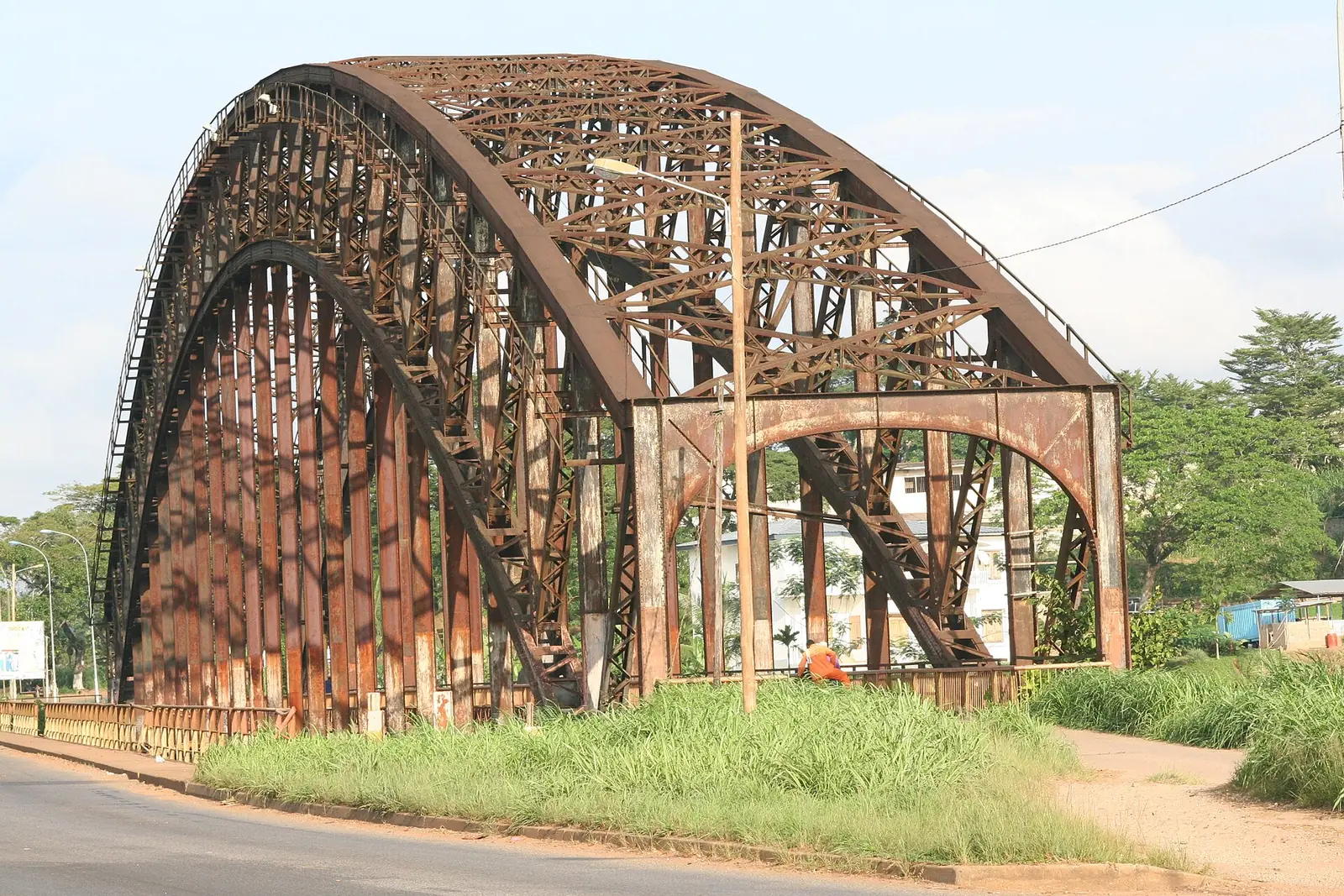
A German-era bridge over the Sanaga
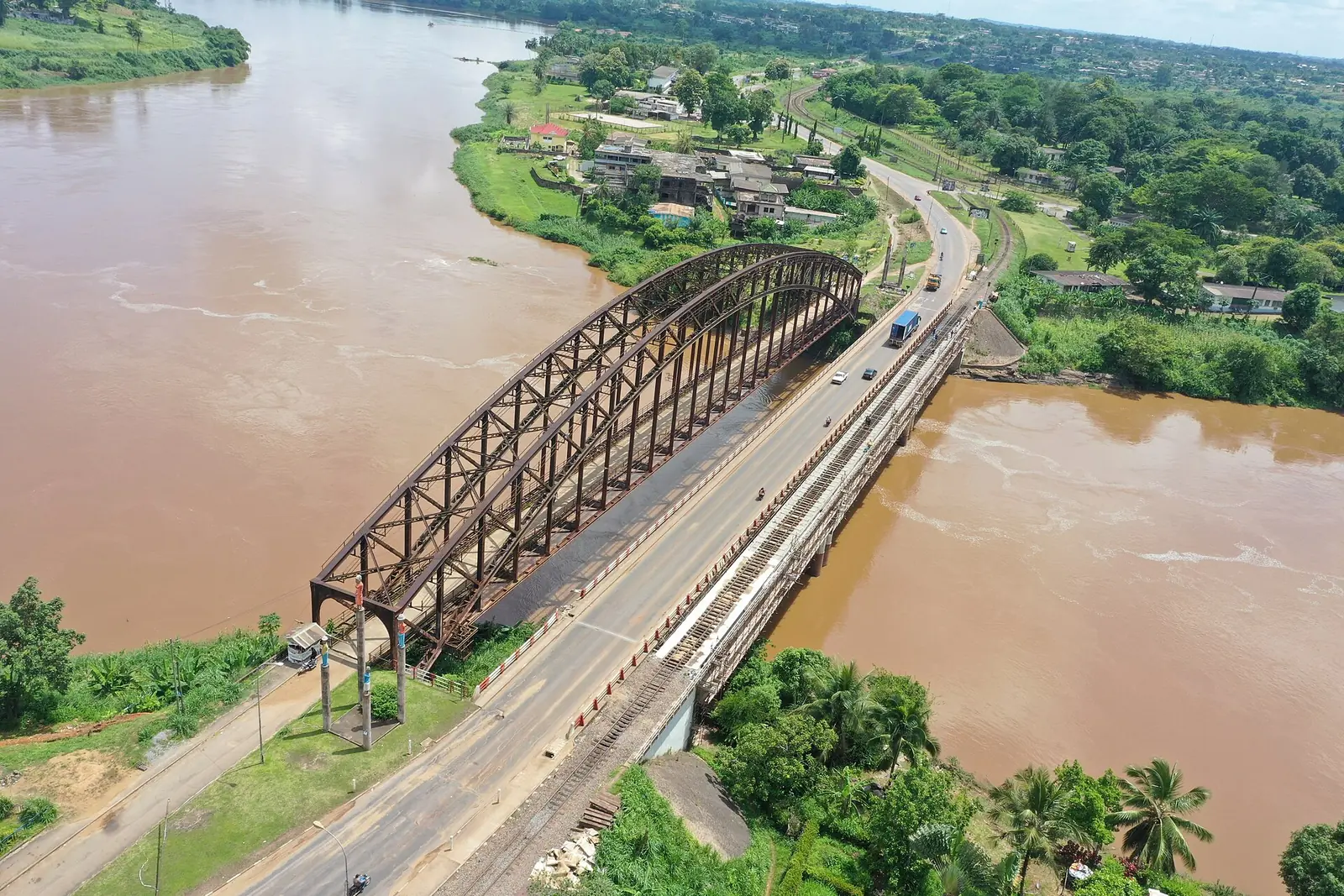
Known locally as the German bridge (pont allemand), this arch bridge crosses the Sanaga at Édéa. It dates from 1911, under German colonial rule. The firm Gutehoffnungshütte of Oberhausen designed and built it, assembled it in Germany for testing, then shipped it to Cameroon in pieces. Half the arch was put together on land and half on floating barges before the two were joined. English Wikipedia calls it steel and French Wikipedia iron.1,2,3
At about 160 m, it was described as the largest bridge of its kind in Africa when it was built. Until the early 1980s it was the only crossing of the Sanaga here for trains, vehicles and pedestrians, on a single lane. It now carries walkers and cyclists. French Wikipedia mentions four statues of men and women on pylons at either end.1,2,3
A centenary and new lights
For the bridge's centenary, the Goethe-Institut organised an arts project on it, linked to 50 years of its work in Cameroon. In July 2025, lighting was installed on the metal structure by the Alliance NYOBIA with the Édéa city council's technical services. The mayor presented it as a way to draw visitors and promote the town's heritage.1,2,3
About the name
English Wikipedia calls this the Japoma Bridge, and French Wikipedia says it was formerly known as the pont de Japoma, without a source. Japoma is a district of Douala, and the 'Japoma railway bridge' in British First World War dispatches was a different, much longer bridge near Douala, over the Dibamba. Local press calls this one the German bridge of Édéa, and the Osidimbea directory the old German bridge.1,2,3,4,5,6
Getting there
In pictures
Map
What visitors say
We summarise accounts published elsewhere and link to the original. These aren't reviews collected by this site, and we don't show a rating.
We haven't yet found a published visitor account for this place.
Check before you go
Our sources can't yet confirm these points:
- Whether the bridge has any formal heritage listing
- Its exact length (sources give about 160 m)
- Whether it is steel or iron
- Whether the statues described on French Wikipedia are still in place
Also nearby
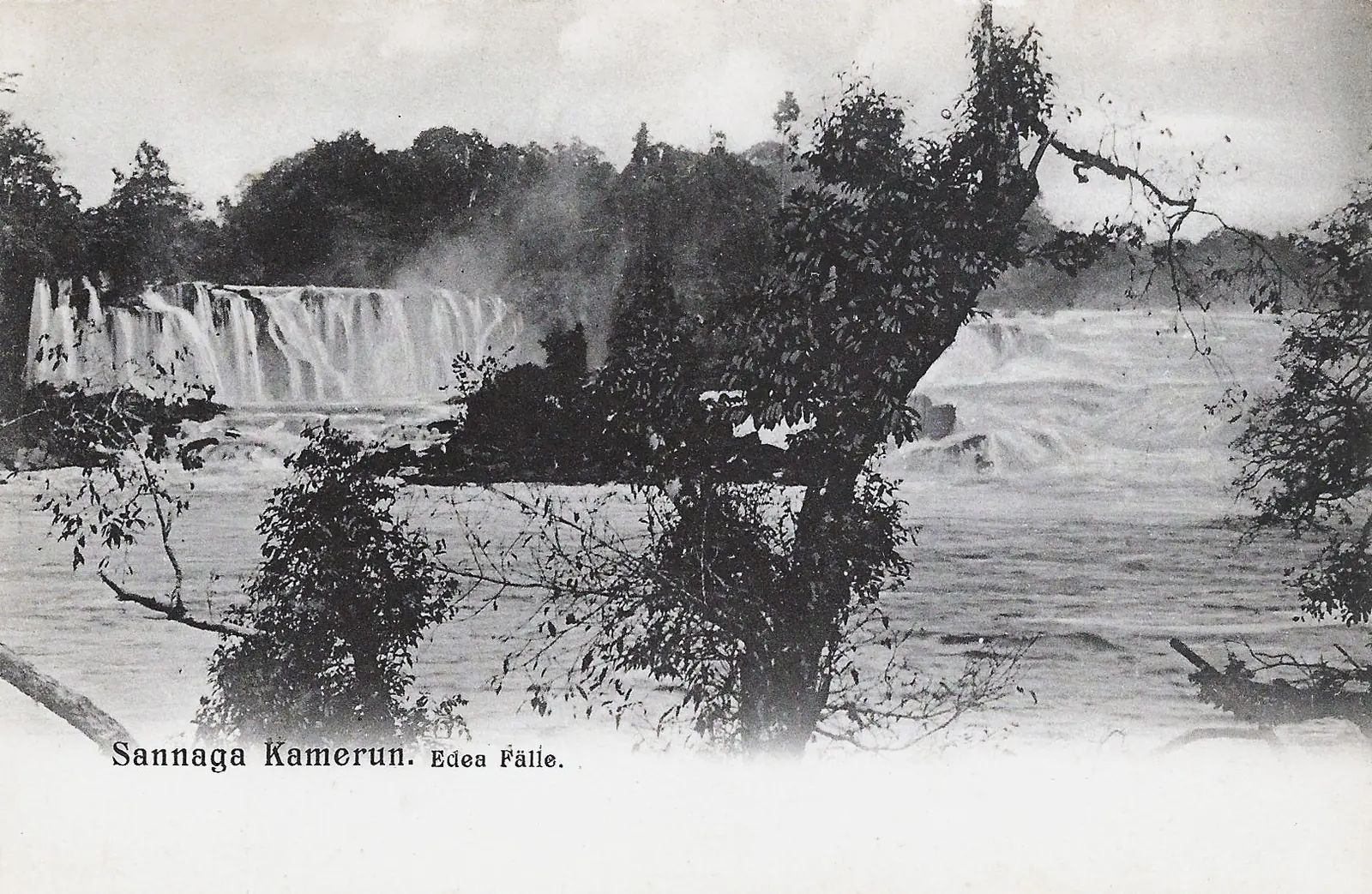
Sources for this page
Information checked on 9 November 2026. It may have changed since.
- Japoma Bridge, Wikipedia (undated)
- Pont allemand d'Édéa, Wikipédia (3 November 2024)
- Cameroun : Révélation – Le pont allemand d'Edéa s'illumine !, 237online (19 July 2025)
- The campaign in Cameroon 1914-1916 (despatch of Maj.-Gen. C. M. Dobell, 1 March 1916), The Long, Long Trail (1 March 1916)
- First Battle of Edea, Wikipedia (undated)
- La ville d'Edéa, Osidimbea (undated)
- Edéa, Wikipedia (undated)
Enquire about German Bridge at Edéa
Visit German Bridge at Edéa
Plan your trip to German Bridge at Edéa in the Littoral Region. Send us an enquiry about guided tours, accommodation and transport, and we'll reply by email.
Send an enquiryLittoral Region
Capital: Douala
Cameroon's economic centre, around the port city of Douala and the Wouri Estuary, with Sawa and Bassa heritage, the Ngondo festival and the Sanaga River at Edéa.
More places in the Littoral Region
Douala Maritime Museum
A ship-shaped museum in Douala's Bonanjo district on Cameroon's coast, ports and ships, with a recreated ship's bridge and a navigation simulator.
La Pagode (Palace of King Bell)
The former palace of the Bell kings in Bonanjo, Douala, built in 1905 and still owned by the Bell family. It was home to Rudolf Duala Manga Bell, hanged by the German authorities in 1914.
Ekom-Nkam Waterfalls
A waterfall of about 80 m on the Nkam river near Melong, set in forest and used as a filming location for Greystoke (1984). A second fall runs beside it in the rainy season.
Wouri Estuary
The tidal estuary where the Wouri, Mungo and Dibamba meet the Atlantic at Douala, lined with mangroves and fishing villages, and the source of Cameroon's name.