A king held to account
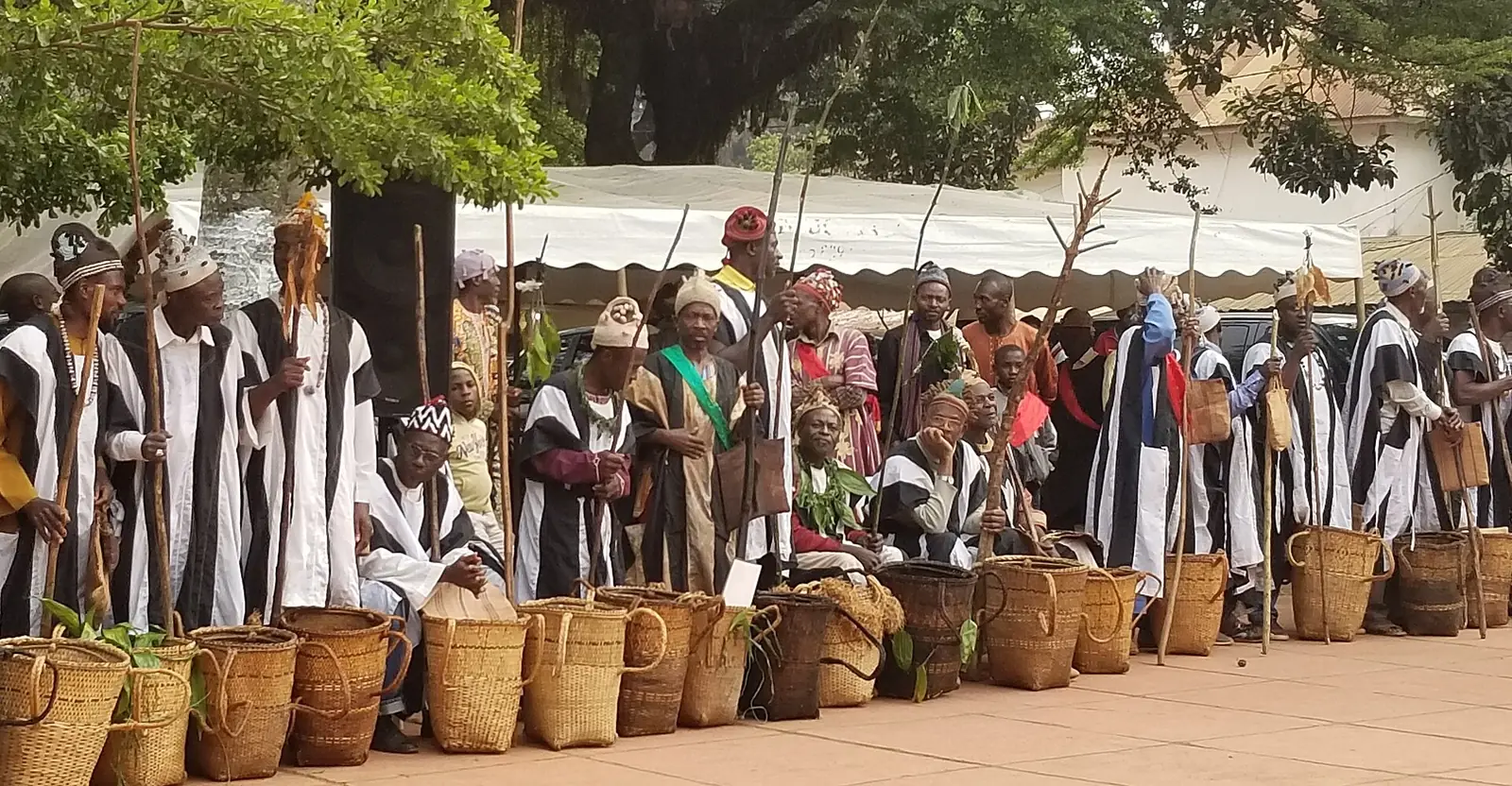
Nguon is a set of rituals between the Mfon, the Bamoun monarch, and his people, held in Foumban. Its aim is dialogue, harmony and peace. Ritual chiefs first gather the community's views on the state of the kingdom. The monarch then faces a public 'trial' of his governance, in which he can be fined or even removed. If he is given a new mandate, he makes a speech, receives renewed allegiance and returns to the palace after popular celebrations.1
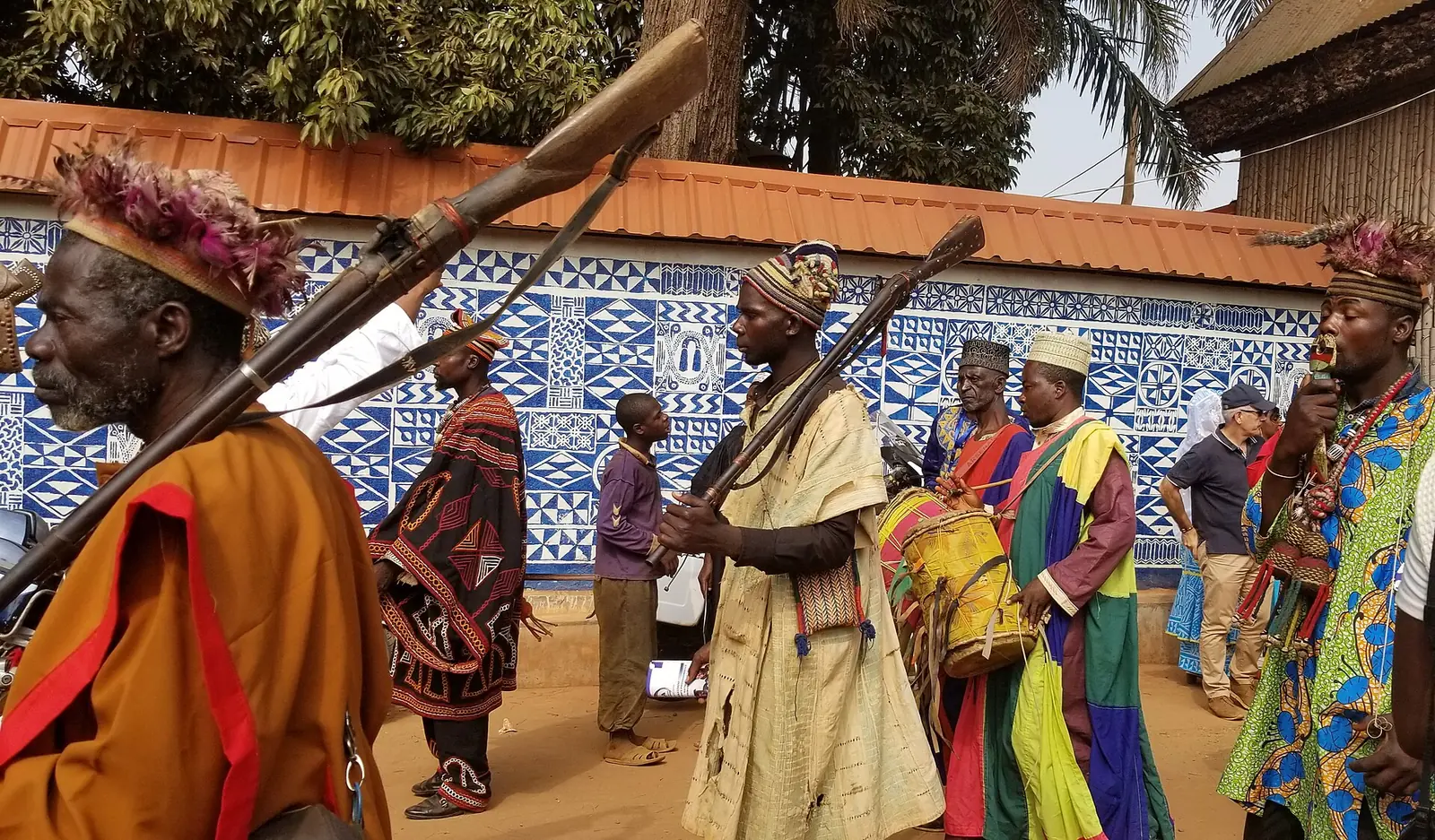
The 2020 national heritage inventory describes the stages. Messengers called Fonaanguon travel through the community collecting grievances and medicinal plants. On the first night they enter the palace in darkness to the sound of a bullroarer. The next morning, in the Sha-Pam, the Mfon gathers their bags of plants. He then walks in procession, escorted by the masked Mbansié society, to the ceremonial courtyard. A notable plants the spear of justice, the Mfon steps down from his throne, and the charges are read. In 2006 the king was ordered to pay twelve oxen. A ram is sacrificed, the Mfon is restored, and on Sunday the people celebrate, a day called Sho' Melue.2
Sources differ on length. UNESCO and the inventory describe three days, Friday to Sunday, while AFP described about a week of rites in 2024, and recent editions have been announced over ten days.1,2,3,4,6
Six centuries, with long pauses
UNESCO says the rituals are more than 600 years old, while AFP dates them to the kingdom's founding in 1384 and calls them nearly 600 years old. According to the inventory, Nguon was annual until 1924, when the French colonial authorities banned it. King Njimoluh Seidou convened it in 1935, 1958, 1963 and 1976, and once more later in his reign. King Ibrahim Mbombo Njoya revived it in 1993 for his father's funeral, held it again in 1994, and then made it biennial.1,2,3
The inventory records an edition in 2018. The next took place only in 2024, after six years, because of Covid-19 and other factors. It was the first for King Mouhammad Nabil Mforifoum Mbombo Njoya, who succeeded his father in 2021. UNESCO inscribed Nguon on its Representative List of the Intangible Cultural Heritage of Humanity in December 2023.1,2,3
Recent and coming editions
The 548th edition was announced for 29 November to 8 December 2024. Cameroon Tribune reported the king's trial on Saturday 7 December 2024 and the closing Sho' Melue march the next day, Sunday 8 December, when warriors with guns, spears and painted faces escorted the king through town to the Nguon village.4,5
The 549th edition has been announced for 4 to 13 December 2026. The king gave these dates in Abidjan in May 2026, and Cameroun Online reports that the Ministry of Arts and Culture recorded them in June 2026, while noting that the schedule must still be confirmed with the organisers. In October 2026 the Rio Times wrote that no organiser had confirmed them. No full programme had been published when we checked.6,7,8
Getting to Foumban
Foumban is about 250 km northwest of Yaoundé and is reached by bus and bush taxi, according to Lonely Planet.9
In pictures
What visitors say
We summarise accounts published elsewhere and link to the original. These aren't reviews collected by this site, and we don't show a rating.
We haven't yet found a published visitor account for this place.
Check before you go
Our sources can't yet confirm these points:
- Final dates and programme of the 549th edition (announced for 4-13 December 2026)
- Which ceremonies are open to visitors, and whether access or photography is restricted
- Accommodation availability in Foumban during the festival
- Age of the tradition: 'more than 600 years' (UNESCO) or founded in 1384 (AFP)
Also nearby

Sources for this page
Information checked on 9 November 2026. It may have changed since.
- Nguon, rituals of governance and associated expressions in the Bamoun community, UNESCO Intangible Cultural Heritage (2023)
- Arrêté portant classement des éléments du patrimoine culturel immatériel au patrimoine national, with the Inventaire général du patrimoine culturel national entry 'NGUON : Rituels autour du pouvoir sacré du Mfon', MINAC, filed with UNESCO (2020)
- Trial of a king: ancient royal ritual in Cameroon promotes peace, Dawn (AFP) (11 December 2024)
- Cameroon - Nguon: next edition scheduled from November 29 to December 08, 2024, Journal du Cameroun (19 December 2023)
- Nguon 2024 : rituels de fin, Cameroon Tribune (9 December 2024)
- Royaume Bamoun - Côte d'Ivoire : le roi des Bamoun invite les acteurs économiques ivoiriens à la 549e édition du Nguon à Foumban, Abidjan.net (9 May 2026)
- Nguon 2026 : les préparatifs de Foumban placent la transmission au premier plan, Cameroun Online (2 November 2026)
- Cameroon Culture 2026: Key Figures, Music, Film and Sport, The Rio Times (23 October 2026)
- Foumban : que faire, Lonely Planet (French edition) (undated)
Enquire about Nguon
Visit Nguon
Plan your trip to Nguon in the West Region. Send us an enquiry about guided tours, accommodation and transport, and we'll reply by email.
Send an enquiryWest Region
Capital: Bafoussam
A highland region of plateaus, crater lakes and chiefdoms, home mainly to the Bamiléké and the Bamoun, with Bafoussam as its capital. Foumban's palace, museums and artisans and the Nguon rituals are among its best-known features.
More places in the West Region
Foumban Royal Palace
Completed in 1917 under King Ibrahim Njoya, this is the seat of the Bamoun kingdom and home of the reigning king. Since April 2024 a large new Museum of the Bamoun Kings has stood nearby.
Rue des Artisans, Foumban
Foumban's Rue des Artisans, between the town's two museums, is home to carvers, weavers and embroiderers, while bronze casters work in the Tanchoua valley just below the Artisanat quarter.
Lake Baleng
A crater lake ringed by hills and eucalyptus on the edge of Bafoussam, sacred to the Baleng people and on Cameroon's national heritage list since 2020.
Bandjoun Chiefdom
The seat of the Bandjoun chiefdom, known for a great hut about 17 m high, rebuilt after a fire in 2005. It also has a museum of nearly 400 objects on forge, art and power.