- Ticket in 2019
- 2,000 CFA8
A working royal seat
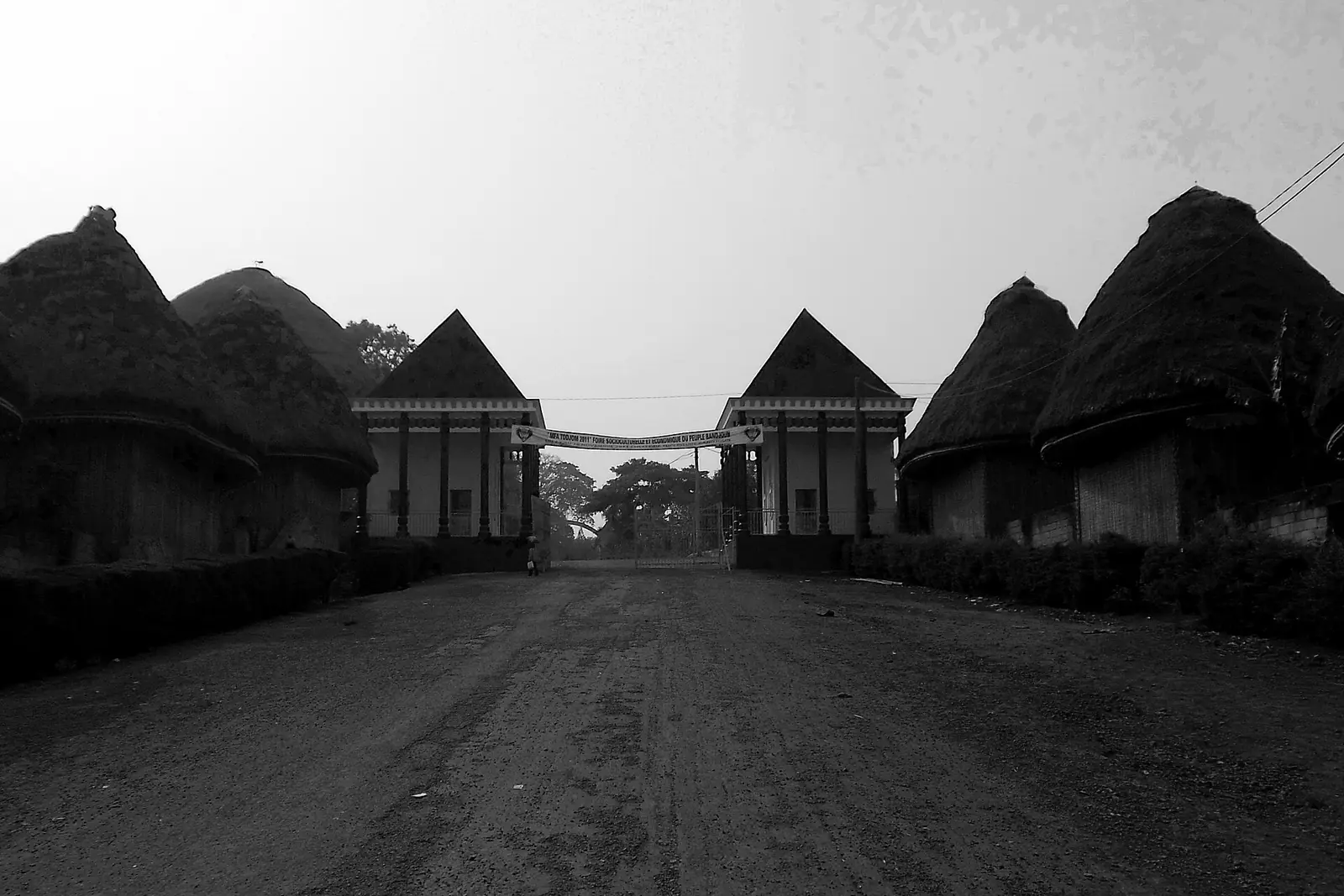
Bandjoun is one of the Bamileke chiefdoms of the West Region. Its compound remains the seat of the chief, Honoré Djomo Kamga, enthroned in 2004 and described by Le360 as the 15th king. A main alley lined with the women's huts leads to the great hut, the compound's best-known building.2,3,8
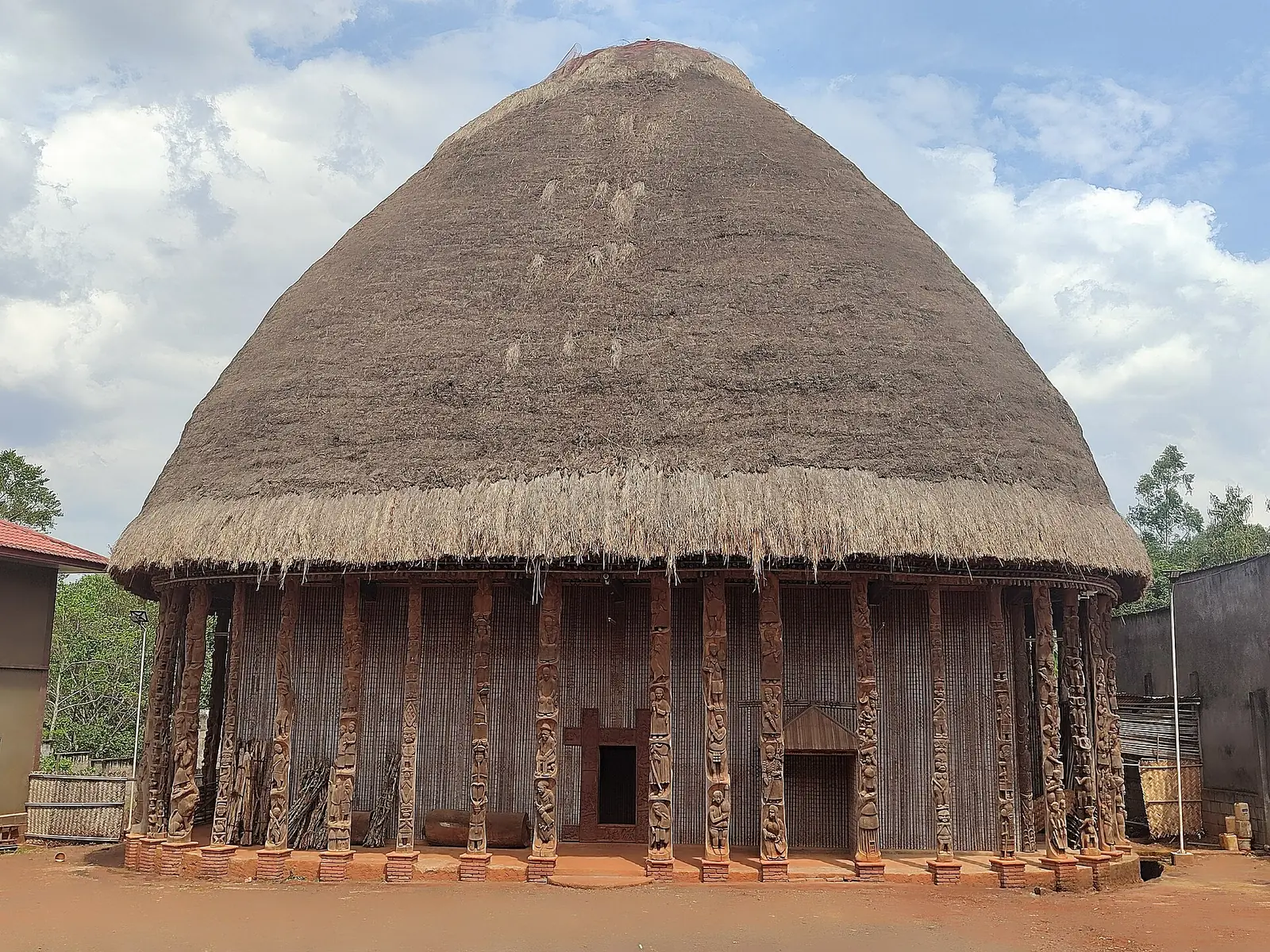
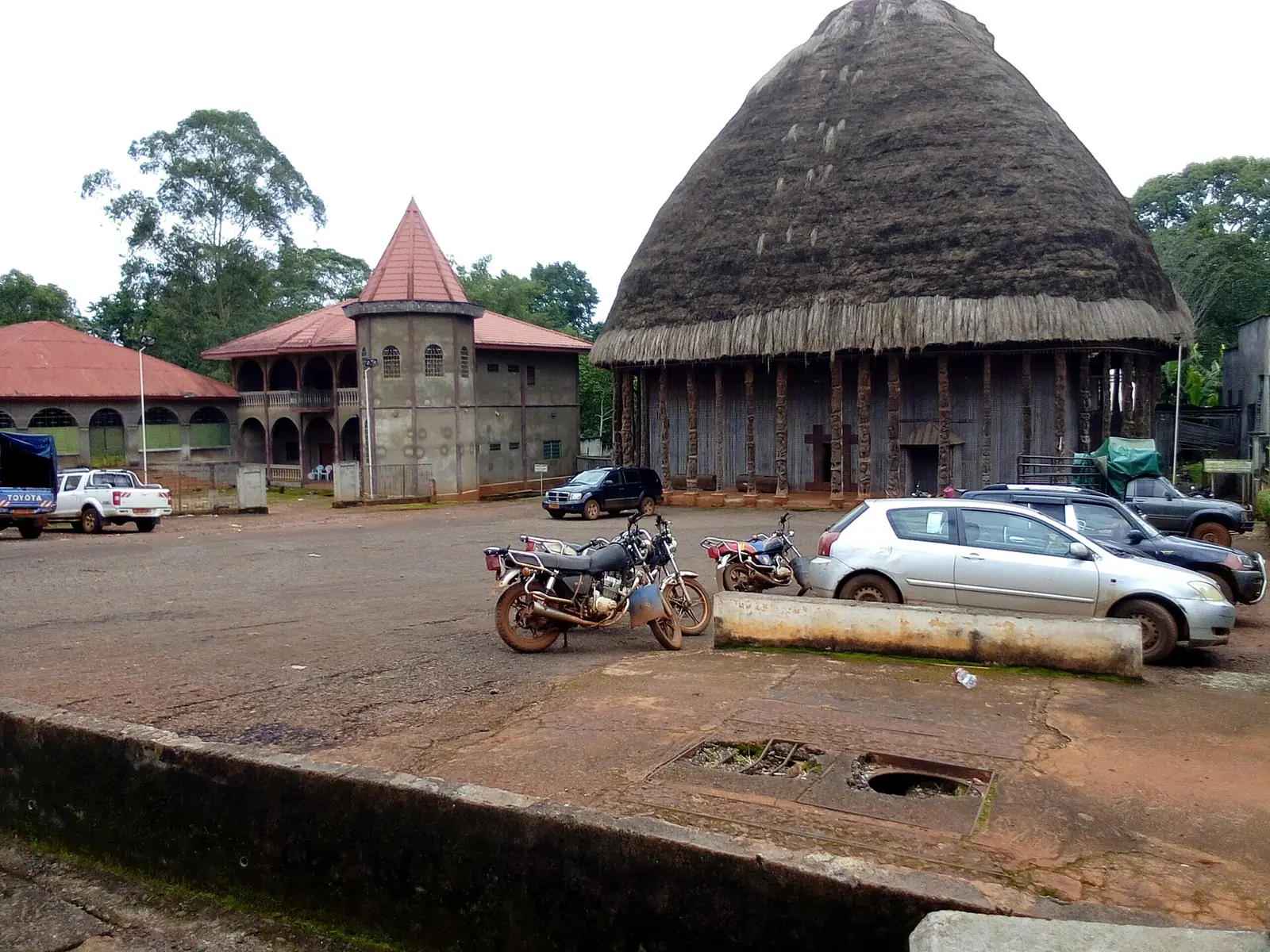
The great hut stands about 17 m high. It is made of bamboo tied with raffia, with carved pillars representing ancestors, and it hosts major ceremonies and meetings of the king's advisers. A sacred forest behind it holds the chiefs' burial place, which only initiates may enter.1,2,8
The founding date is unsettled. Wikipedia reports dates from 1525 to 1570 and says it was probably 1570, while its own list of rulers begins earlier and is flagged for checking. Le360 says the 16th century, and French Wikipedia speaks of the 17th.1,2,3
A history of fires
Fire has struck the compound repeatedly, so what you see is largely rebuilt. A 2015 report in Le Jour lists fires in February 1935, January 1958, January 2005 and January 2015. A 2018 master's thesis instead describes a very destructive fire in 1959, during the independence war, that destroyed the great hut of the time. The report also dates the third fire to 2004 in one place and 2005 in another, and a report from January 2005 settles it as 2005.4,5,7
The 2005 fire destroyed the great hut, two buildings from the 1930s and the museum's reserve of about a thousand objects, some from the 18th century, plus palace archives. The 122 pieces in the permanent exhibition room survived, and the hut was rebuilt in about three years. Wikipedia's claim that the hut is about four centuries old, with pillars that survived three fires, cites no source, so we don't repeat it as fact.1,4,5
On 11 January 2015 another fire burned 16 huts, including the women's huts, in the part of the compound spared in 2005. The chief announced rebuilding later that month. When two visitors came in 2019, the women's huts had been rebuilt with non-flammable roofs.5,6,8
The museum
The museum's theme is forge, art and power, with nearly 400 objects and 25 display panels. Wikipedia lists beaded gourds and statues, ivory statuettes, masks, thrones and hunting trophies, along with a 25 kg dance hat worn only by the chief at the annual festival. Sources disagree on where it is: French Wikipedia says inside the great hut, while Wikipedia and the 2019 visitors treat it as a separate building, a large modern one according to Wikipedia.1,2,8
Costs and access
Sources differ on access, so check before you travel. In September 2019, two visitors paid 2,000 CFA each for tickets and 2,000 CFA for permission to take photos outside, and left the guide a 1,000 CFA tip. Photos were not allowed inside the museum. The site officially opened at 9 am, though they found reception still closed at 9:25. In 2022, Le360 wrote that foreigners may only enter on exhibition days.3,8
How to get there
The chiefdom lies on the N4 towards Bagangté, about 20 km south-east of Bafoussam according to Wikivoyage and Wikipedia, though another passage of the same Wikipedia page puts Bandjoun about 10 km south of the city. Wikivoyage says most cities have vehicles to Bafoussam, naming Binam, Merveilles and General from Yaoundé. Rome2Rio puts Bafoussam about 251 km by road from Douala and about 292 km from Yaoundé.1,9,10,11
Where to stay
Bafoussam is the nearest base we found listed. Wikivoyage names several hotels there, including Hotel Zingana, inspired by Bamileke traditions, and Hôtel Altitel, without prices.9
In pictures
Map
What visitors say
We summarise accounts published elsewhere and link to the original. These aren't reviews collected by this site, and we don't show a rating.
Found the museum small and less complete than the one in Dschang but still very interesting. They singled out the great hut and its carved columns, and praised their guide.
Christine and Thierry Dupin, Gandalf On Tour, 2 September 2019
Check before you go
Our sources can't yet confirm these points:
- Current entry and photo fees, and opening hours
- Whether foreign visitors can enter outside exhibition days, as Le360 reported in 2022
- A contact for the chiefdom or its museum
- Where the museum is within the compound
- The exact distance from Bafoussam, and current minibus or taxi fares
- The official cause of the 2015 fire, and how much of the rebuilding is finished
Also nearby
Sources for this page
Information checked on 6 November 2026. It may have changed since.
- Bandjoun, Wikipedia (undated)
- Chefferie de Bandjoun, Wikipédia (24 March 2025)
- Cameroun: au cœur du Royaume de Bandjoun, un peuple qui a su conserver ses valeurs ancestrales, Le360 Afrique (31 July 2022)
- Cameroun : une partie du patrimoine bandjoun s'envole en fumée, Afrik.com (21 January 2005)
- Bandjoun : le feu à l'ombre du baobab, Le Jour, republished by Camer.be (23 January 2015)
- Chefferie Bandjoun : la reconstruction lancée, Le Jour, republished by Camer.be (27 January 2015)
- Patrimoine culturel Bandjoun : destruction et stratégies de protection, Jacques Simo Djilo, master's thesis, Université de Dschang (2018)
- Bandjoun, Cameroon, Gandalf On Tour, travel blog (12 September 2019)
- Bafoussam, Wikivoyage (undated)
- Douala to Bafoussam, Rome2Rio route planner (undated)
- Yaoundé to Bafoussam, Rome2Rio route planner (undated)
Enquire about Bandjoun Chiefdom
Visit Bandjoun Chiefdom
Plan your trip to Bandjoun Chiefdom in the West Region. Send us an enquiry about guided tours, accommodation and transport, and we'll reply by email.
Send an enquiryWest Region
Capital: Bafoussam
A highland region of plateaus, crater lakes and chiefdoms, home mainly to the Bamiléké and the Bamoun, with Bafoussam as its capital. Foumban's palace, museums and artisans and the Nguon rituals are among its best-known features.
More places in the West Region
Foumban Royal Palace
Completed in 1917 under King Ibrahim Njoya, this is the seat of the Bamoun kingdom and home of the reigning king. Since April 2024 a large new Museum of the Bamoun Kings has stood nearby.
Rue des Artisans, Foumban
Foumban's Rue des Artisans, between the town's two museums, is home to carvers, weavers and embroiderers, while bronze casters work in the Tanchoua valley just below the Artisanat quarter.
Lake Baleng
A crater lake ringed by hills and eucalyptus on the edge of Bafoussam, sacred to the Baleng people and on Cameroon's national heritage list since 2020.
Museum of Civilizations, Dschang
Opened in 2010 beside Dschang's municipal lake, this museum presents Cameroon's history and its four cultural areas. It grew out of a twinning between Dschang and Nantes that ran until 2015.