- Bronze casting
- Practised since the 18th century1
- Street founded
- 1925, by Mosé Yéyap1
- From Yaoundé
- About 250 km2
A town that lives from its crafts
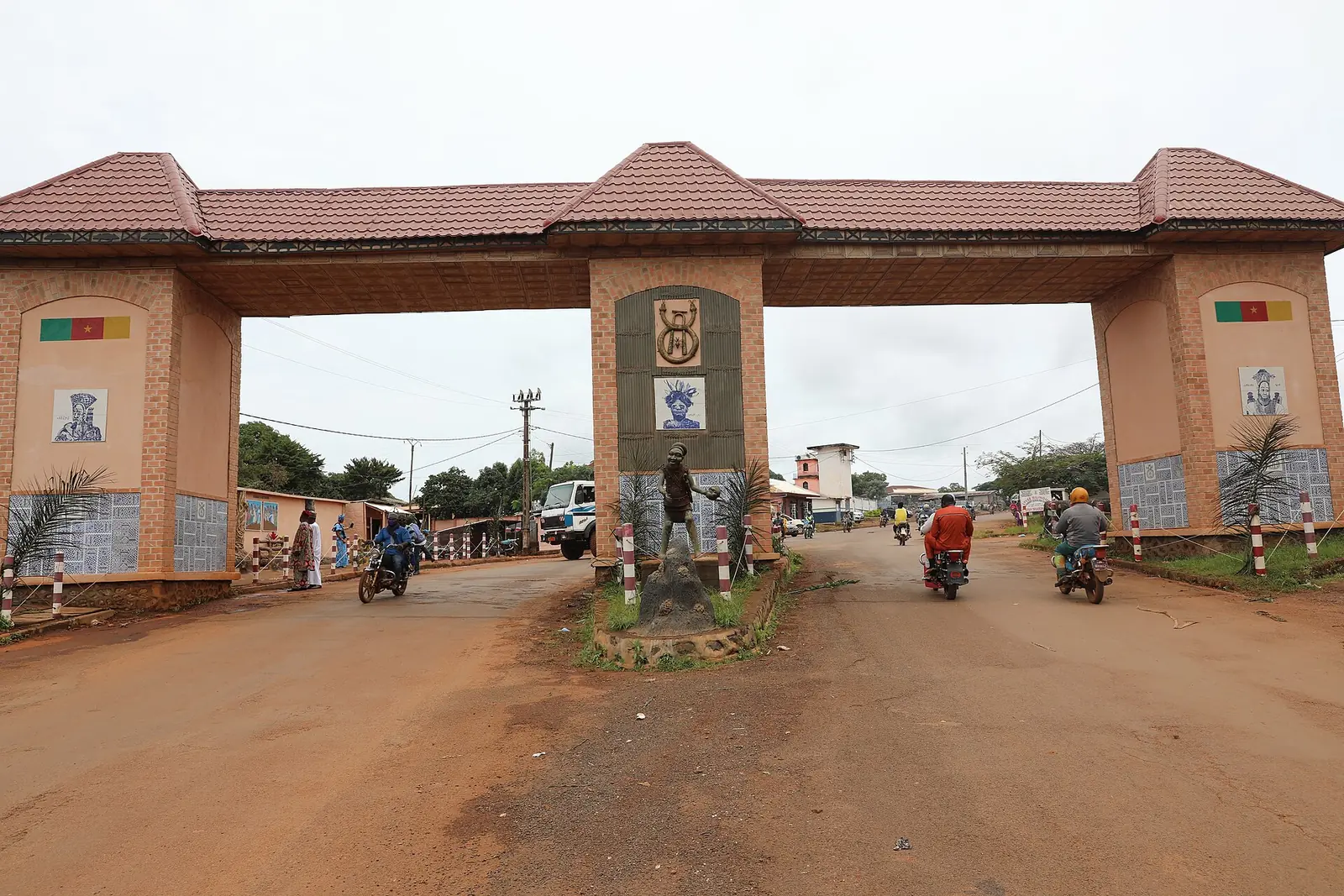
Foumban, seat of the Bamoun kingdom in the Noun department, built its reputation on crafts, according to the national heritage inventory of 2020, and Wikipedia calls artwork its main source of income. The Rue des Artisans links the town's two museums. Sculptors, basket makers, weavers and embroiderers work along it, and Lonely Planet and Wikipedia both call it one of the best places in Central Africa to buy wood carvings. Wikivoyage places it just south of the palace, with a 'supposedly'.2,3,4,6
Lonely Planet places the Musée des Arts et Traditions Bamoun about 100 m south of the palace. Its collection of Bamoun history and art includes kitchen utensils, musical instruments, pipes and masks.2
Street and quarter
A 2026 study by researcher Luc Bertrand Ondobo, citing earlier research, says the Rue des Artisans was created at Njissé in 1925 by Mosé Yéyap. He calls the Artisanat quarter, also called Njiyouom, the heart of Foumban's art. A bridge over the small Tanchoua river links Njiyouom to Njissé. The name Tanchoua means 'place of dispute': near that bridge, King Njoya and his mother Njapdounke are said to have argued over Islam and Christianity.1
Bronze and brass
Lost-wax casting has been practised in Foumban since the 18th century. A craft researcher's 2001 photo essay shows the method: wax is modelled over a clay core, covered in clay with wax rods to form channels, then heated so the wax runs out. Molten metal is poured in, the mould is broken away and the piece is finished with a file. Bronze, brass and silver are all cast in the town.1,5
Ondobo's fieldwork, carried out between 2022 and 2025, found eight casting and welding workshops in the Tanchoua valley, just below the Artisanat quarter. They are set up in their owners' homes, and most of the casters are related, learning the trade within the family. He reports that raw materials are becoming scarce and costly and that sales are hard, so some casters are considering other work.1
Getting there and staying
What visitors say
We summarise accounts published elsewhere and link to the original. These aren't reviews collected by this site, and we don't show a rating.
We haven't yet found a published visitor account for this place.
Check before you go
Our sources can't yet confirm these points:
- Whether the Tanchoua workshops welcome visitors, and on what terms
- Opening hours and entry fee of the Musée des Arts et Traditions Bamoun
- Current prices for carvings and castings
- Bus and bush-taxi routes and fares from Bafoussam and Yaoundé
Also nearby
Sources for this page
Information checked on 9 November 2026. It may have changed since.
- Les Maîtres Fondeurs-Soudeurs du Bronze de la Vallée du Tanchoua à Foumban au Cameroun (Luc Bertrand Ondobo), Éditions EFUA / ACAREF (2026-02)
- Foumban : que faire, Lonely Planet (French edition) (undated)
- Foumban, Wikivoyage (undated)
- Foumban, Wikipedia (undated)
- Metal Casting in Foumban, Cameroon, Africa, Carol Ventura (craft researcher's photo essay) (2001)
- Arrêté du Ministre des Arts et de la Culture portant classement des éléments du patrimoine culturel immatériel au patrimoine national, with Inventaire général du patrimoine culturel national (Cameroun 2020), MINAC, filed with UNESCO (21 February 2020)
Enquire about Rue des Artisans, Foumban
Visit Rue des Artisans, Foumban
Plan your trip to Rue des Artisans, Foumban in the West Region. Send us an enquiry about guided tours, accommodation and transport, and we'll reply by email.
Send an enquiryWest Region
Capital: Bafoussam
A highland region of plateaus, crater lakes and chiefdoms, home mainly to the Bamiléké and the Bamoun, with Bafoussam as its capital. Foumban's palace, museums and artisans and the Nguon rituals are among its best-known features.
More places in the West Region
Foumban Royal Palace
Completed in 1917 under King Ibrahim Njoya, this is the seat of the Bamoun kingdom and home of the reigning king. Since April 2024 a large new Museum of the Bamoun Kings has stood nearby.
Lake Baleng
A crater lake ringed by hills and eucalyptus on the edge of Bafoussam, sacred to the Baleng people and on Cameroon's national heritage list since 2020.
Bandjoun Chiefdom
The seat of the Bandjoun chiefdom, known for a great hut about 17 m high, rebuilt after a fire in 2005. It also has a museum of nearly 400 objects on forge, art and power.
Museum of Civilizations, Dschang
Opened in 2010 beside Dschang's municipal lake, this museum presents Cameroon's history and its four cultural areas. It grew out of a twinning between Dschang and Nantes that ran until 2015.